Who’s Running for Fresno County Judge? Candidate Profiles and Fundraising
 QWER
QWER
Who will preside on the bench at the Fresno County Superior Court?
Judges are publicly elected, although opportunities for voters to decide are rare. Often, judges leave the bench midterm, allowing the governor to appoint a new jurist. For the June 2 election, Fresno County voters will see seven judicial races, with six featuring more than one candidate.
To run, a candidate must be admitted to practice law in California for 10 years immediately preceding an election or appointment. The term is six years.

GV Wire sent questionnaires to the candidates to learn more about their backgrounds and judicial philosophies. Read part one here. The following is a summary of the candidates’ answers, edited for length.
Seat 8: Daniel J. Brickey
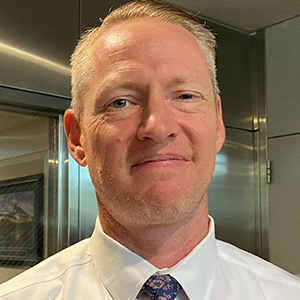
Brickey, a court commissioner, is the only candidate in the race. He will succeed David Gottlieb, who opted not to run for re-election.
The state court system describes a court commissioner as performing “judicial and quasi-judicial functions, with primary responsibility for adjudicating cases, including acting as a temporary judge in appropriate cases and performing other related duties as assigned.” Commissioners are selected by a majority vote of judges on the court.
He did not return the questionnaire by the time of publication.
According to his LinkedIn page, Brickey earned his Juris Doctor from San Joaquin College of Law in 2009 after graduating from Fresno State. He worked in private practice for a few years and then joined the Fresno County Office of the Public Defender in 2012. Registered with no party preference, he has served as a court commissioner since 2023. His brother, Gabriel Brickey, is a Fresno County Superior Court judge.
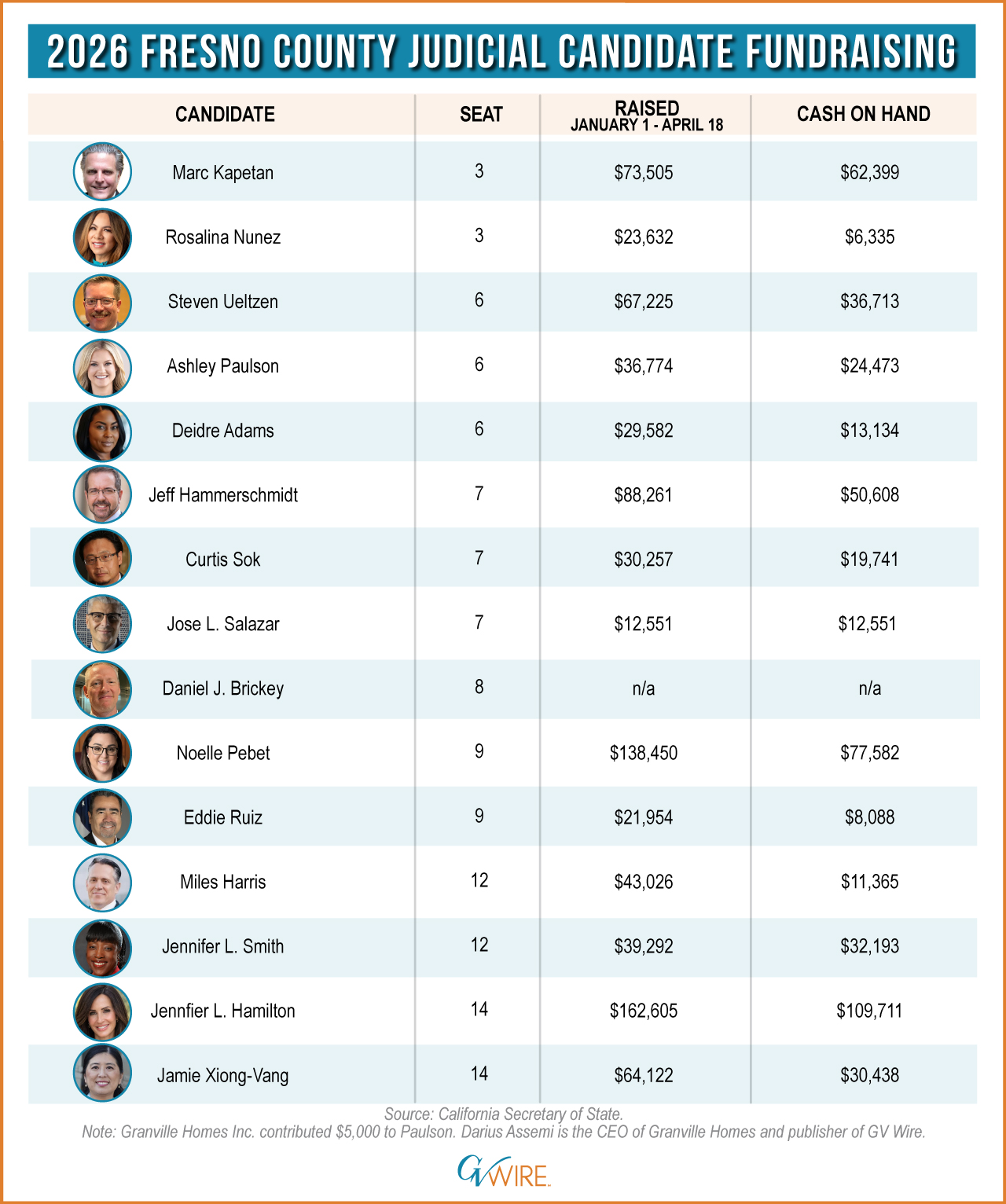
Brickey has not raised funds.
Seat 9: Noelle Pebet, Eddie Ruiz
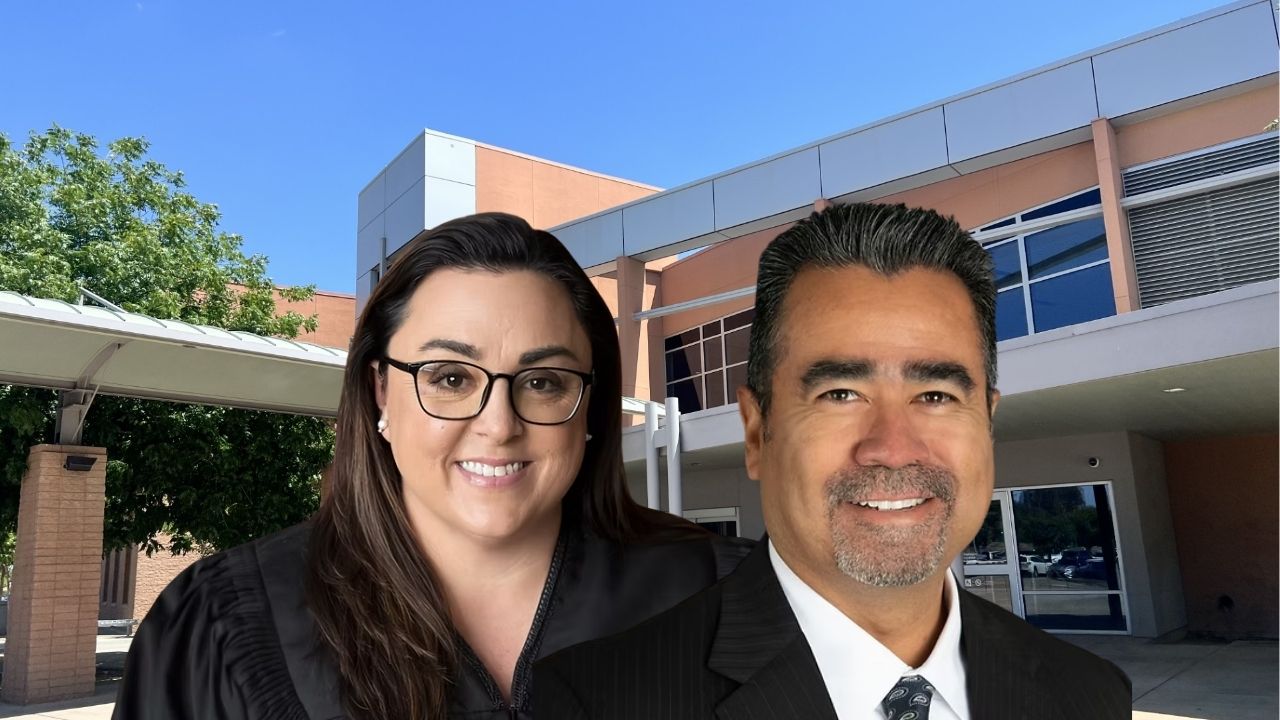
Pebet, a Fresno County Superior Court commissioner, and Ruiz, a private-practice defense and personal injury attorney, are seeking to replace Elizabeth Egan, who opted not to run for re-election.
Ruiz reported raising $21,954 from Jan. 1 to April 18, the most recent reporting period, with $8,088 cash on hand. He has loaned his campaign $15,000. Several contributors are attorneys, including $1,000 from Fresno civil rights attorney Kevin Little.
He is familiar with public office, serving as a member of the Washington Unified School District board.
Pebet reported raising $138,450, with $77,582 cash on hand. She loaned her campaign $100,000. Her largest contributor is Joseph Pebet, listed as a mechanic for United Airlines, at $25,000. Several other judges, including Michael Idiart — her uncle — Gary Green, Stephanie Negin, Kimberly Gaab, William Hamlin and Charles Lee, contributed.
She earned her Juris Doctor from Golden Gate University School of Law in San Francisco in 2005 after graduating from the University of San Francisco. Pebet worked for the Fresno County District Attorney’s Office from 2007 to 2019, where she conducted 40 trials, including 10 homicide cases, and headed the gang unit. She became a court commissioner in 2019.
According to her campaign website, Pebet’s family operated the Santa Fe Basque Hotel in downtown Fresno.
Noelle Pebet
Experience: “I have nearly 20 years of legal experience, including just under 13 years as an attorney and seven years serving as a commissioner, during which I have maintained my law license with the State Bar.”
Prior office: Court commissioner, 2019-present.
Have you ever applied to be a judge before with the governor’s office: “Yes, I applied in March 2023. ”
Political party: “I am running for a nonpartisan position and am honored to be supported by Democrats, Republicans and members of other parties.”
Registration records show Pebet is registered with no party preference.
What is your most well-known case: “In my 12 years at the district attorney’s office, I exclusively handled gang and homicide cases for the last seven years, including a death penalty prosecution.”
Pebet declined to answer questions on her judicial philosophy, citing judicial ethics rules that prevent candidates from answering certain questions about how they might rule in specific cases.
“With respect to sentencing, I will faithfully apply the law as written. I will consider the factors set forth in the Penal Code and California Rule of Court 4.410 and carefully weigh the circumstances of the offense, the impact on the victim and the background of the defendant in determining an appropriate and just sentence.”
What are your thoughts on the court’s rollout of the new eCourt system: “In the grand scheme of things, I believe it has gone well, and I applaud the thousands of hours staff worked behind the scenes to make that transition as smooth as possible. As with anything new, it continues to be a work in progress.”
Eddie Ruiz
Experience: 30 years. “I began at a local law firm representing indigent clients. After two years, I opened my own firm. In addition, I handled a variety of cases, including family law, breach of contract, real estate-related cases, probate, bankruptcy, victims of sexual abuse, and those who have been wrongly and gravely injured or killed by the extreme negligence of others.”
Prior office: “In 2016, I was elected to the Washington Unified School District Board of Trustees. I still serve in that position. I currently hold an appointed position as a board trustee at San Joaquin College of Law. I attended and graduated from San Joaquin College of Law.”
Have you ever applied to be a judge before with the governor’s office: Yes, in 2023.
Political party: American Independent.
What is your most well-known case: “I recently represented three teenage girls who were victims of sexual assault by their third-grade teacher. The parents retained my services to file claims on their behalf, and I secured a monetary settlement to aid in their healing and future stability.”
If a suspect is convicted of vehicular manslaughter, will you impose the maximum penalty: “Somebody who has committed vehicular manslaughter should be held fully accountable under the law, but a judge is legally required to take all factors into account. If, as a judge, I did not do this, I would risk my sentences being overturned.”
What factors do you use in determining sentencing? Will you lean more lenient or more toward the maximum: “Anybody who has victimized another person should be held fully accountable under the law. But any judge who does not look at each individual case risks their sentences being over-turned. An example of a mitigating factor would be a victim of domestic violence who has killed her abuser. This is very different than a rapist who has killed his victim. Context and facts must be considered.”
Can sex offenders be rehabilitated? “The term ‘sex offender’ can be a broad umbrella. A 20-year-old who has a sexual relationship with his 17-year-old girlfriend could be viewed as a sex offender. This individual most likely can be rehabilitated if he is held accountable with an appropriate sentence that includes supervision and counseling. On the other hand, there are individuals who, statistically, are unlikely to be rehabilitated and must be incarcerated and handled differently to protect public safety.”
What are your thoughts on the court’s rollout of the new eCourt system: “The court’s rollout of the new eCourt system was relatively smooth. There were some short delays, but it appears that court staff are adapting well to the system.”
What can the court do to become more transparent:“The court should continue to communicate basic information to the public. For example, in family law, it should continue providing basic literature about filing documents related to child custody and visitation. Court clerks should be well-trained to provide general information. All court staff and employees should treat the public with courtesy and respect.”
Seat 12: Miles Harris, Jennifer L. Smith
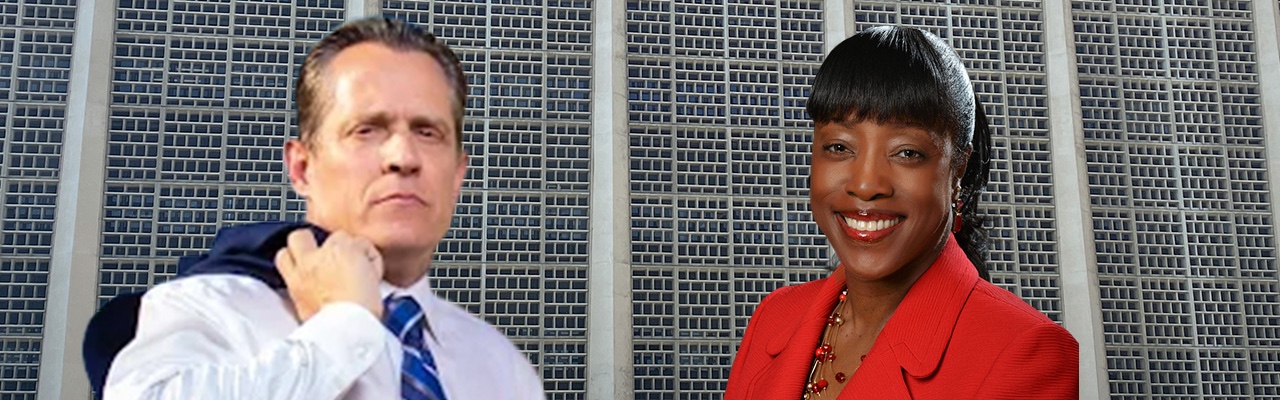
The seat to replace John Vogt, who opted not to seek re-election, pits a private practice criminal defense and family law attorney (Harris) against a veteran prosecutor (Smith).
Both list notable endorsements. Smith’s list includes Fresno County District Attorney Lisa Smittcamp, Fresno County Sheriff John Zanoni, and Fresno Mayor Jerry Dyer. Harris has the backing of former Fresno Mayor Alan Autry, who is helping run his campaign.
Smith raised $39,292, with $32,193 cash on hand. She loaned her campaign $20,000. She also received $6,000 loans each from Sybil Smith, an educator from Los Angeles, and Alexia Kirkland, an attorney from Torrance.
Her campaign website said she was born and raised in Fresno County. She attended Fresno City College and Long Beach State before earning her Juris Doctor from Western State University College of Law in 1985.
Smith has worked as a prosecutor for the Fresno County District Attorney’s Office for nearly 30 years. She also served as a temporary judge in Fresno County from 2017 to 2020.
Harris raised $43,026 — including a $35,000 loan to his campaign — with $11,365 cash on hand.
Miles Harris
Experience: 21 years. “Since 2011, I have operated my own law practice, representing individuals and businesses throughout the Central Valley. Over time, my practice has developed into a robust criminal defense and family law practice, handling matters ranging from misdemeanors to complex multi-defendant felony cases, as well as representing victims of domestic violence in obtaining protective orders. My work has been recognized by The Fresno Bee’s Best of Central California People’s Choice Awards for the past five years. In addition, by special request of the court, I have been asked by courts in this county and others to handle complex dependency and guardianship matters, further broadening my experience.”
Prior office: No.
Have you ever applied to be a judge before with the governor’s office: No.
Political party: No party preference.
What is your most well-known case: “People v. Jerel Stanfield. This case involved a 2013 murder in which Jerel Stanfield was accused of a homicide occurring in the early hours of the morning March 31, 2013. Later that afternoon, after a police pursuit, Jerel Stanfield was shot by police while fleeing from officers. Stanfield was subsequently arrested and charged with murder, felony evading and additional charges. The result was a hung jury 7-5 on the murder charge.”
If a suspect is convicted of vehicular manslaughter, will you impose the maximum penalty: “When a judge is looking at a case with this level of importance, the sentencing decision is guided by statute and sentencing rules ultimately weighing aggravating and mitigating factors tied to the offense and the offender. In California, vehicular manslaughter can fall under different statutes (e.g., with or without gross negligence and/or while intoxicated), and that classification heavily influences sentencing exposure.
“Upon completing the appropriate analysis, if and when appropriate I would impose the maximum penalty.”
What factors do you use in determining sentencing? Will you lean more lenient or more toward the maximum: “In California, judges don’t sentence in the abstract — they follow a structured set of rules that tell them what to weigh and how to justify their choices. The core framework comes from the California Rules of Court and the Penal Code. Under California Rules of Court Rule 4.410, the overarching goal is that the sentence be proportionate to the seriousness of the offense and the defendant’s culpability.”
Can sex offenders be rehabilitated: “Ultimately, rehabilitation depends in large part on the individual. Meaningful rehabilitation begins with acknowledging the problem, accepting responsibility, and committing to the sustained work required. Lasting change is only possible when the individual follows through on the treatment plan and remains engaged until completion. Similar to sobriety, rehabilitation requires a lifelong commitment.”
What are your thoughts on the court’s rollout of the new eCourt system: “The general consensus has been that official guidance has been limited. This has been found to include court staff and personnel as well. Users have faced forced workflow changes, significant manual re-setup tasks, and lingering uncertainty about the future direction of the e-filing portal following the March filing disruption. The most consistent complaint is a communication gap. Although the court announced the new system would take effect April 1, 2026, the public website lagged behind the email notices sent to filers and did not clearly explain the transition. When courts change systems without clear, timely guidance, confusion and anxiety grow quickly. This led to uncertainty around procedures and timelines, and the temporary paper-filing blackout intensified frustration.”
What can the court do to become more transparent: “The court’s overall solution to better transparency comes from clearer communication with the different groups of people it regularly serves and interacts with. Right now, information is somewhat scattered and delayed. A permanent public page should include real-time system status, known issues and workaround, upcoming changes and timelines, and an archive of past updates. Transparency should also include some statistics on filings, case backlogs, clearance rates, and time-to-resolution in a format understandable to the public. While review of such data may be sobering at times, it allows for some accountability and better research toward workable solutions.”
Jennifer L. Smith
Experience: “I have been an attorney for 37 years, of which 30 of those years I have worked for Fresno County District Attorney’s office.”
Prior office: No, although Smith said she served as a judge pro tem from 2017-2020 in the Fresno County Superior Court.
Have you ever applied to be a judge before with the governor’s office: No.
Political party: Smith did not answer, but registration records show she is a Democrat.
What is your most well-known case: She did not answer.
Smith did not answer judicial philosophy questions directly, but did write:
” As a judicial officer, I will follow the law and take everything into consideration for sentencing involving all convictions. I will decide the case on its merits and ensure that all objectives for sentencing guidelines have been observed. I will also use my experience as a judge pro tem to ensure effective courtroom management.
What are your thoughts on the court’s rollout of the new eCourt system: Smith did not answer.
What can the court do to become more transparent:“I hope for more public awareness of collaborative courts, such as DUI Court, Veterans Court, Mental Health Diversion Court, Adult Behavioral Health Court and Unity Court. This will give the public the information needed to assist friends and family members who are struggling with mental health and substance abuse issues.”
Seat 14: Jennifer L. Hamilton, Jamie Xiong-Vang
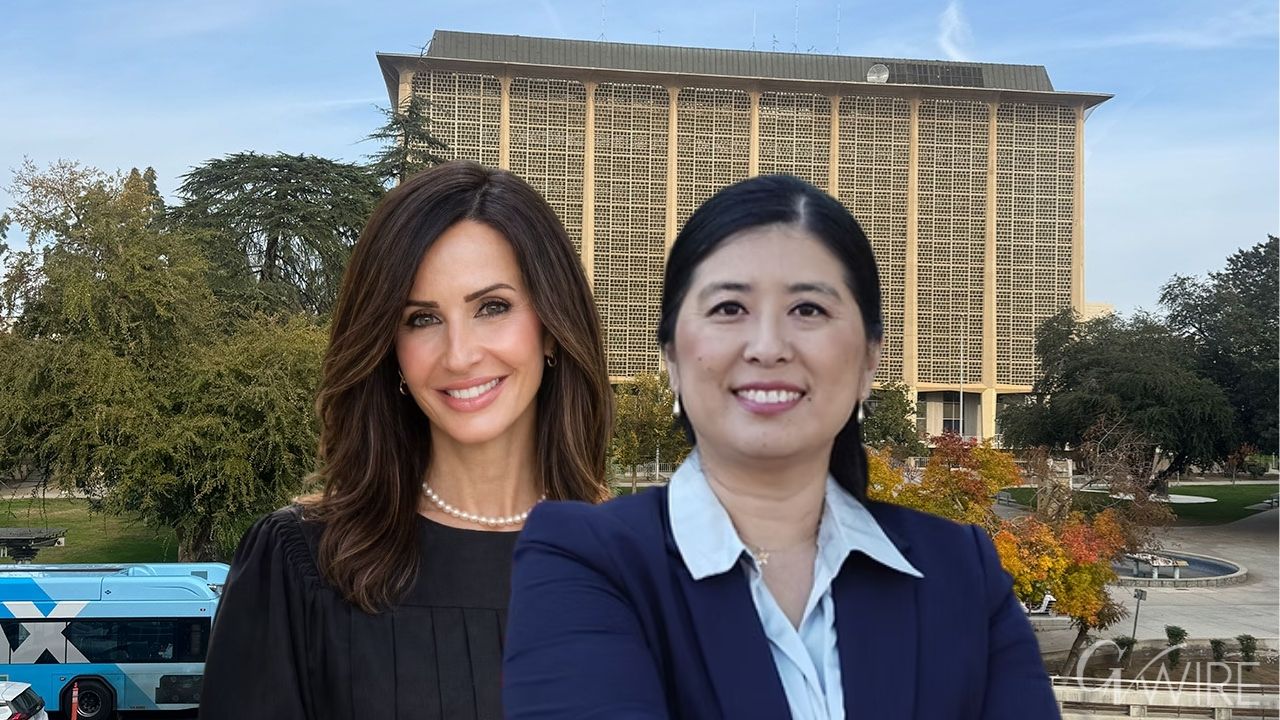
Two jurists are seeking to replace Kimberly Nystrom-Geist, who opted not to run for re-election.
Jennifer L. Hamilton is a Fresno County Superior Court commissioner. Jamie Xiong-Vang is a state administrative law judge for the California Department of Social Services.
Hamilton raised $162,605 during the reporting period, with $109,711 cash on hand. Several contributions came from judges Robert Mangano, Bob Whalen, Kristi Kapetan, Stephanie Negin, Michael Idiart, David Kalemkarian, Leanne Le Mon, Kimberly Gaab and James Kelly, and commissioners Katherine Fogarty, Gary Green, and Jeff Spivak.
Fresno developer Edward Kashian contributed $20,000. Attorney Warren Paboojian contributed $10,000.
Her husband, Jeff Hamilton Jr., presiding judge of the Fresno County Superior Court, loaned the campaign $40,000.
Xiong-Vang raised $64,122, with $30,438 cash on hand and a $5,000 loan to her campaign. Her notable contributors include Joaquin Arambula, who gave $756 from his City Council campaign account; Fresno Unified Superintendent Misty Her, who gave $200; and Fresno City Councilmember Brandon Vang, who gave $100.
Xiong-Vang, a registered Democrat, did not return a questionnaire.
Jennifer L. Hamilton
Experience: “I was admitted to practice in December 1996. I currently serve as a commissioner with the Fresno County Superior Court and have done so for more than six years. I also serve as the supervising judicial officer in the Family Law Division. I began my legal career in Fresno in 1997 as a juvenile defense attorney with Barker & Associates, now Fitzgerald, Alvarez & Ciummo. While there, I was recruited and hired by the District Attorney’s Office, where I served as a deputy district attorney for nearly a decade. After my time as a prosecutor, I balanced raising my children while representing parolees in revocation hearings with the California Parole Advocacy Program and later handling a broad array of criminal cases at the Fresno County Public Defender’s Office. Before becoming a Superior Court commissioner, I spent several years in Juvenile Dependency Court, representing both minors and parents.”
Prior office: No.
Have you ever applied to be a judge before with the governor’s office: Yes, in April 2023.
Political party: No party preference.
What is your most well-known case:“I have presided over very large and complex divorces in which the parties own vast businesses and have millions of dollars in assets; I have also presided over cases in which the couple’s assets are so limited that they must remain in the same household during their dissolution. In addition, I preside over cases involving child custody, child support and spousal support. In each one, the issues are often similar but unique to the particular case. Each one is significant to me, and it is the most important case to the litigants going through the stress of a family law matter.
“Although divorces are public record, I am not comfortable naming significant or well-known cases because it would violate my duty to uphold the integrity and dignity of the office as found in Canons 1 and 2. It would also violate the prohibition on discussing cases that have come before the court or could come before the court. Finally, it could be seen as demeaning to other litigants whom I did not name as well-known.”
Hamilton cited judicial ethics rules restricting answers on judicial philosophy.
“Expressing my philosophy on this or any other issue would be expressing an opinion on an issue that could come before the court or has come before the court, and I am thus unable to answer.”
What are your thoughts on the court’s rollout of the new eCourt system: “Like any new technology change, the first few weeks are always challenging as everyone becomes accustomed to the new user interface. It has the potential to be a better, safer and more customizable system for our court than our legacy systems.”
What can the court do to become more transparent:“Our court, through judicial officers like me, engages in many community outreach programs to ensure equal access to justice for all in our community. I have participated for a number of years in youth programs such as Youth Court in High School, as well as the National High School Mock Trial competition as a judge. Our court follows the law regarding open courtrooms and uses an electronic case management system that has made open court case records far easier for members of the public to examine. Before the transition to an electronic filing system during Odyssey, a member of the public or the press would need to physically come to the court, get a clerk’s assistance pulling a file and then pay to make copies. That changed with the advent of electronic filing.”
Candidate Fundraising Totals
The post Who’s Running for Fresno County Judge? Candidate Profiles and Fundraising appeared first on GV Wire.