

Portland-Area County Hit With Class Action Lawsuit for Race-Based Homeless Policies

Multnomah County, Ore., was hit with a class action lawsuit on Monday over its race-based homeless programs, which promise that "[p]eople of color will be served at higher rates" than white people and include "culturally specific" apartments for the "BIPOC Community."
The lawsuit against Multnomah, which oversees homeless services for most of Portland, comes as the county is already under investigation by the Department of Housing and Urban Development. It alleges that the county denied a disabled woman rent relief because she did not score high enough on the county's points-based system for allocating homeless services, which awards more points for interest in "culturally specific services" than for having a disability.
Applicants must score at least 19 points in order to be eligible for rent relief, according to the complaint. The plaintiff in the lawsuit, Michele Mei, fell just shy of that cutoff because she did not express an interest in "culturally specific services for African Americans," "Native Americans," or the "Latinx community."
When Mei attempted to reapply, a service provider allegedly turned her away, stating that the "county has told us to only help people of color at this time." She left without completing an application.
Mei, who filed a separate complaint in April under the Americans with Disabilities Act, was initially representing herself pro se. Now, though, she is being represented by Consovoy McCarthy—the law firm behind Students for Fair Admissions v. Harvard—and challenging the race-based policies head-on.
The new complaint has transformed a minor lawsuit into a high-stakes legal battle: if Mei wins, the county will owe damages to all white applicants who were denied rent relief due to their race. Other defendants named in the lawsuit include Home Forward, Portland's public housing corporation; Metro, a government entity that funds the rent assistance program; and Transition Projects, a nonprofit that helps conduct the intake process for the program.
"Unlike the county, our law is colorblind," the complaint reads. "Multnomah County's long-term rent assistance program violates the law. This Court should award all appropriate relief."
Multnomah County and Home Forward did not respond to a request for comment.
The complaint relies heavily on the Multnomah Services and Screening Tool—a race-based scoring rubric first reported by the Washington Free Beacon—which awards two points for requesting "culturally specific services," one point for "[i]nterest in LGBTQ services," and two points for "English as a second language."
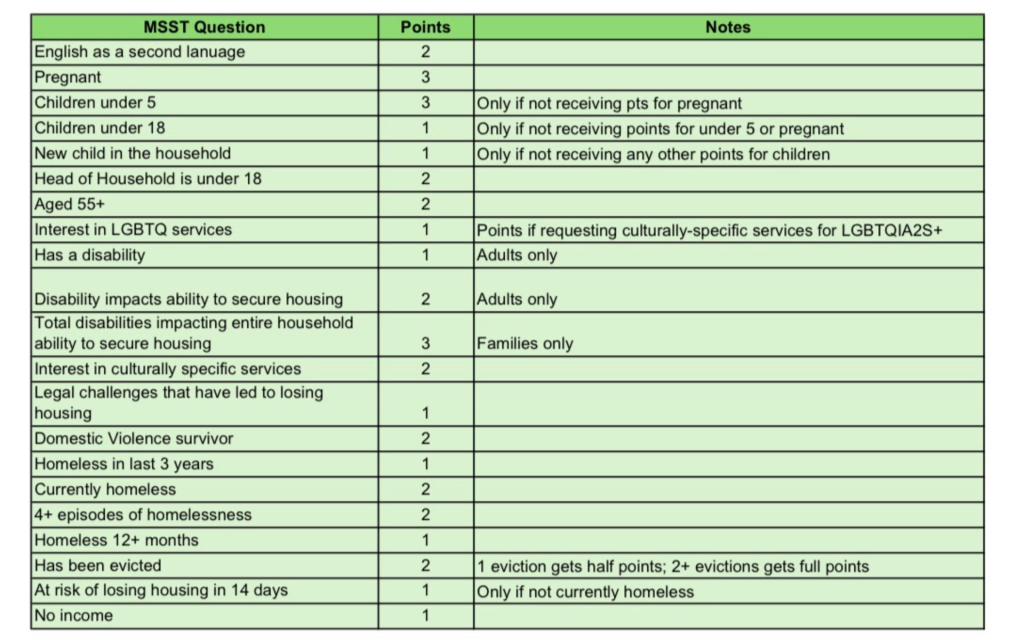
"[B]ecause the cutoff for access to Regional Long-Term Rent Assistance is pegged at around 19 points, the applicant's racial and ethnic identity can make or break whether she qualifies for the program," the complaint states. "If a non-Hispanic white applicant expresses an interest in culturally specific services (services for African Americans, Native Americans, or the Hispanic community), that expression of interest may be disregarded, resulting in no extra points because of her race."
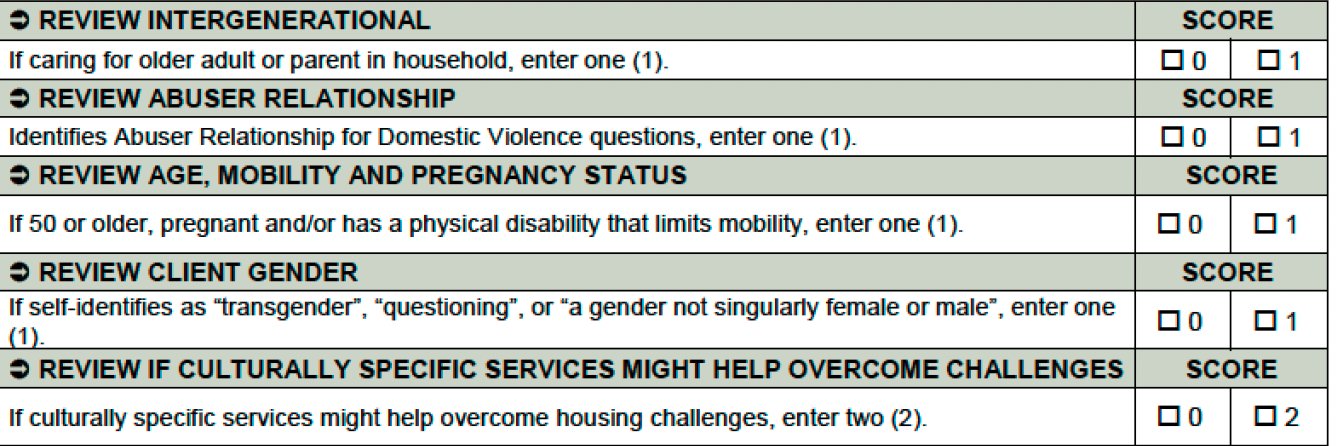
Adopted in 2024, the rubric replaced a separate scoring system, the Vulnerability Index Service Prioritization Decision Assistance Tool (VI-SPDAT), which likewise awarded two points for interest in "culturally specific services"—twice as many as were allocated for being disabled or surviving domestic abuse. An applicant who "self-identifies as 'transgender,' 'questioning,' or 'a gender not singularly female or male'" would receive one additional point.
Mei completed the VI-SPDAT at least twice in 2022 but failed to qualify for rent relief. She applied five additional times under the new scoring system—which the county "designed to prioritize … BIPOC households, LGBTQIA2S+, [and] people with disabilities"—only to narrowly miss the 19-point cutoff. In one case, a county official texted Mei that she had scored a 17 on the assessment tool but that "we're currently referring households with a slightly higher score than that," implying that she would have qualified if she had expressed interest in culturally specific services.
"Had Mei been given the two extra 'culturally-specific' points awarded for race and ethnicity, she would have qualified for long-term rent assistance," the complaint argues. "The rubric further disadvantaged Mei by awarding no point for '[i]nterest in LGBTQ services' ... because she is heterosexual and thus did not express such an interest."
Eventually, Mei began telling assessors that she was interested in culturally specific services, which the county claims are "open to everyone regardless of race or identity." But according to the complaint, county officials refused to check that box and award Mei the two points.
"Graders at Multnomah County also apply the rubric in a race-conscious way to disfavor white applicants," the lawsuit asserts. "That is to say, they exercise discretion not to award marginal points to white applicants in circumstances where they would award those points to non-white applicants."
That practice may reflect the racial targets of the county's homeless services department, which states that "Black, Indigenous, and other people of color (BIPOC) will be served at higher rates than the general population … to account for and correct racial disparities."
The department plans to spend more than $200 million on race-based programs over the next financial year, according to a Free Beacon analysis. And Multnomah sets aside a significant portion of its supportive housing stock for racial minorities: Transition Projects, for example, provides "tenant-based supportive housing services for trans and non-binary adults, BIPOC households, and project-based supportive housing for 12 justice involved adults," according to a report by Home Forward.
Other race-based housing projects include the Hattie Redmond Apartments, which "provide culturally specific housing for the chronically displaced BIPOC community," and the Barbur Apartments, which will "focus on immigrant and refugee communities, specifically Muslim and East and North African households" when it opens in 2027.
It is not clear whether these initiatives have actually improved outcomes for minorities: Between 2023 and 2024, more than 80 percent of the department's programs reported a decline or no change in the diversity of their clientele.
"[T]urning away white applicants simply because of their race does nothing to remedy historic instances of unlawful discrimination against applicants of other races," the complaint reads. "Defendants denied Mei long-term rent assistance despite knowing that they were discriminating against her because of her race."
The post Portland-Area County Hit With Class Action Lawsuit for Race-Based Homeless Policies appeared first on .
 Like
0
Like
0
 Dislike
0
Dislike
0
 Love
0
Love
0
 Funny
0
Funny
0
 Wow
0
Wow
0
 Sad
0
Sad
0
 Angry
0
Angry
0








Comments (0)