New York Times Columnist Nicholas Kristof's Wife, Recently Appointed Vice Chair of Harvard Board of Overseers, Is a Member of a Beijing-Aligned Group Linked to Chinese Government
 QWER
QWER
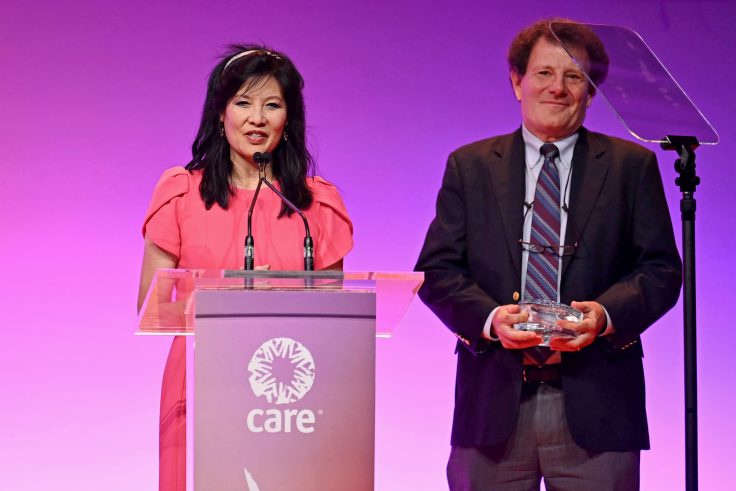
The wife of embattled New York Times columnist Nick Kristof, who along with Kristof worked as a Times correspondent in China and was recently appointed vice chair of the executive committee of Harvard's Board of Overseers, is a member of a Chinese government-linked group known for "doing Beijing's bidding in the US."
The group, the New York-based Committee of 100, works to strengthen relations between the United States and China—or "bridge America and China," as its website states. The committee's membership roster includes Sheryl WuDunn, touting her as a "co-author with her husband, columnist Nicholas D. Kristof, of five best-selling nonfiction books." It also includes a number of Chinese Americans with extensive ties to Chinese Communist Party-linked groups.
Committee member Ronnie Chan, for example, serves on the board of the China-United States Exchange Foundation, a "registered foreign agent bankrolled by a high-ranking Chinese government official with close ties to a sprawling Chinese Communist Party apparatus that handles influence operations abroad," according to Foreign Policy. Another member, Yu Meng, was reportedly recruited by China's Thousand Talents Program—which the FBI considers part of "China's non-traditional espionage against the United States"—to work as deputy chief investment officer of the Chinese government agency State Administration of Foreign Exchange. Meng told the official CCP newspaper People's Daily in 2017 that he took the job out of "a deep affection for my motherland; my roots are in China." The People's Daily has since deleted the article.
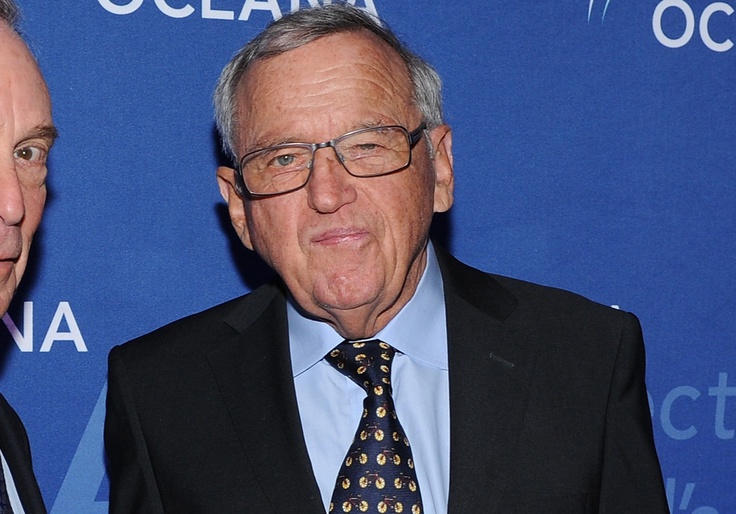
The committee's former leaders, meanwhile, are affiliated with the CCP's "United Front" system, which aims to "influence the American people and interfere in democratic societies," as former House Select Committee on China chairman Mike Gallagher (R., Wis.) put it in 2023. Former longtime member George Koo, who served "on multiple sub-committees" before his death in 2024, was an "overseas director" of the United Front group China Overseas Friendship Association, according to a 2019 Hoover Institution report, which said the Chinese government "targets prominent Chinese Americans through the Committee of 100," pressuring them to "toe the Party line." Former Committee of 100 chair H. Roger Wang is also affiliated with the China Overseas Friendship Association—he serves as an honorary chairman of its local branch in Nanjing, according to Newsweek.
Those affiliations—along with the committee's general silence on CCP human rights abuses (it has only vaguely referred to "the Chinese government's crackdown on Uyghurs" in an unrelated bio for a Times reporter and has never mentioned the word "Xinjiang" on its website)—have prompted criticism from pro-democracy activists in Hong Kong and praise from Chinese leader Xi Jinping. A longtime adviser to the jailed Hong Kong businessman and democracy activist Jimmy Lai, Mark Simon, in a 2019 column called the Committee of 100 "a pro-Beijing group, concerned almost exclusively with the interests aligned with those of the Chinese Communist Party," that is "doing Beijing's bidding in the US." Four years prior, Xi called the committee one of several "friendly groups."
The revelation of WuDunn's status as a Committee of 100 member comes as Kristof faces intense criticism for a controversial Times piece that alleged "sexual violence" against Palestinians in Israeli detention—and as WuDunn starts a new role at Harvard.
Critics of the column have noted that Kristof has a history of botched reporting, retractions, and apologies, notably his articles about a Cambodian activist who he said was trafficked in brothels as a child, a story that Kristof later acknowledged was likely fake. Kristof also propagated falsehoods about Steven Hatfill, the U.S. government scientist who was wrongfully suspected of being the perpetrator of the 2001 anthrax attacks. Kristof ultimately apologized publicly to Hatfill.
Kristof has also been criticized for his rosy portrayals and incorrect predictions about Xi, China's ruthless strongman. In 2013, he wrote that Xi would engage in "some political easing," release Nobel Peace Prize winner Liu Xiaobo from prison, and remove the body of Mao Zedong from its mausoleum in Beijing, none of which happened. He also called Xi a "reformer," writing, "It's in his genes." Years earlier, in 2006, Kristof declared that "China is not the police state that its leaders sometimes would like it to be" and predicted that the "Communist Party dictatorship" could not "survive the Internet."
WuDunn, for her part, was recently named vice chair of Harvard's Board of Overseers, the Ivy League school's second-highest advisory board, which "exerts broad influence over the University's strategic directions" and "provides counsel to the University leadership on priorities and plans," according to Harvard. The Justice Department sued Harvard in March for "race and national origin discrimination against Jewish and Israeli students."
Kristof, WuDunn, and Harvard did not respond to requests for comment. A Committee of 100 spokesman confirmed that WuDunn "is a member in good standing" and said that both the group and its members with links to Chinese government entities have not been accused of misconduct.
"C100 is an American institution. It is incorporated in the United States, governed under U.S. law, and accountable to American stakeholders," the spokesman said. "Its mission is rooted in core American values: democracy, openness, civic participation, and equal opportunity."
"Committee of 100 condemns covert foreign influence efforts targeting American institutions, whether by China or any other nation," he continued. "At the same time, we believe scrutiny should be grounded in evidence and should not rely on guilt by association or assumptions about the civic loyalty of Chinese Americans."
Kristof and WuDunn worked as the Times's only correspondents in Beijing starting in 1988, shortly after they married. They developed a close friendship with Chinese diplomat Zhang Hanzhi, "who had been Chairman Mao's English teacher, a senior Foreign Ministry official and the wife of the foreign minister," and with the children of powerful Chinese Communist Party officials, as Kristof wrote in his 2024 memoir Chasing Hope. While in China, Kristof "took on a role as interviewer of Chinese high school students applying to Harvard," writing that he was "dazzled by the caliber of the applicants." WuDunn ultimately left the Times to make money, working as an investment banker at Goldman Sachs and later focusing on "new media technology, entertainment, social media, healthcare, and emerging markets, in particular, China," according to an online bio. She has been wildly celebrated by the liberal establishment, having served on the principal boards of both Cornell and Princeton. WuDunn is believed to charge large sums for paid speaking engagements.
The Committee of 100, like Harvard, has squabbled with the Trump administration. It called President Donald Trump's executive order aiming to revoke birthright citizenship a "divisive policy" that would harm "Chinese Americans and other individuals born on U.S. soil" and said Secretary of State Marco Rubio's revocation of some Chinese student visas "distorts facts and fuels discrimination against Chinese Americans."
The post New York Times Columnist Nicholas Kristof's Wife, Recently Appointed Vice Chair of Harvard Board of Overseers, Is a Member of a Beijing-Aligned Group Linked to Chinese Government appeared first on .