How Trump’s Giant Arch Would Compare to Others Across the World
 QWER
QWER
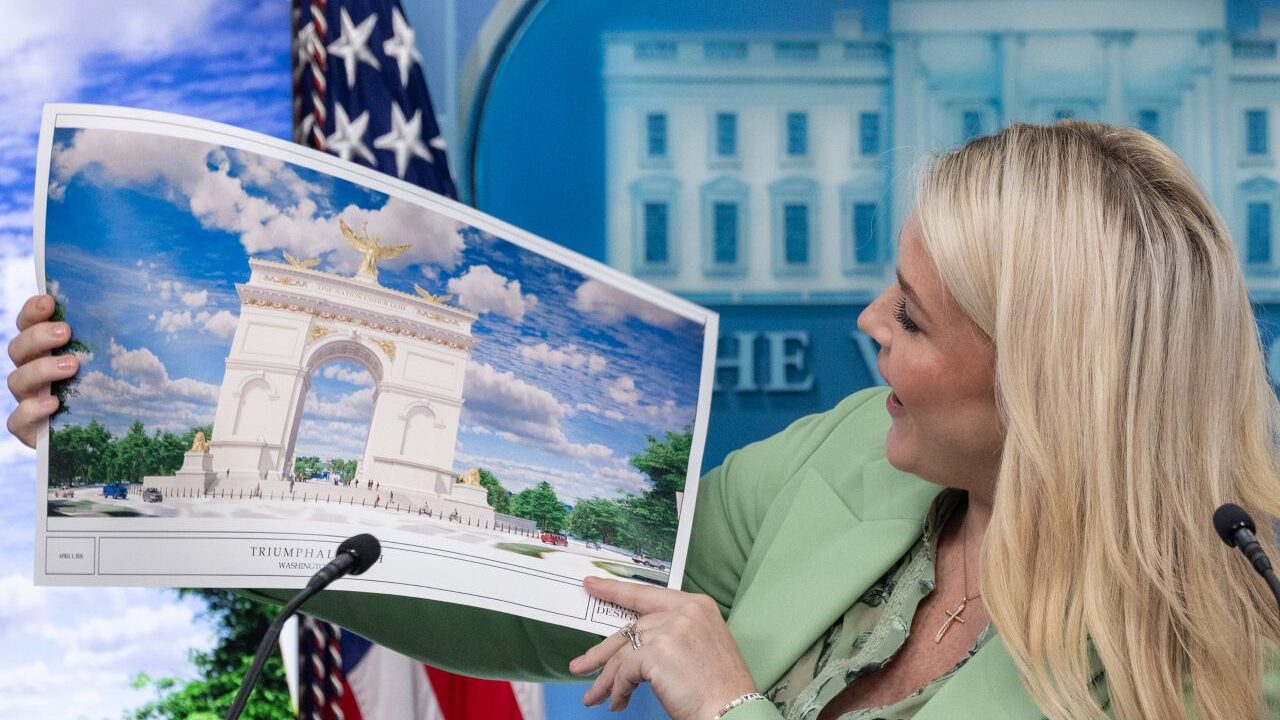
The federal Commission of Fine Arts on Thursday preliminarily approved plans for a hulking 250-foot “triumphal arch” to celebrate America’s 250th birthday, one of several construction projects President Donald Trump has conjured up in an effort to leave his aesthetic mark on Washington.
Despite the preliminary approval, the panel’s vice chair suggested major changes, including the removal of a winged statue on top of the arch that makes up the final third of the 250-foot height Trump desired.
The Trump administration was asked to return with updated drawings before a final vote by the panel, which is stacked with Trump allies and holds only an advisory role.

Arch Would Be Built Near Arlington National Cemetery
Trump wants the arch to rise up from a roundabout near Arlington National Cemetery, across the Potomac River from the Lincoln Memorial. The design prominently features the heavy gold embellishments that have come to be known as a signature Trump style.
The arch, whose cost the administration has not released, carries the feel of a Trump design for another reason: As originally proposed, it is simply massive.
Although it is loosely modeled on the Arc de Triomphe, the neoclassical monument in Paris commissioned by Napoleon, the arch Trump proposed would dwarf that by about 86 feet.
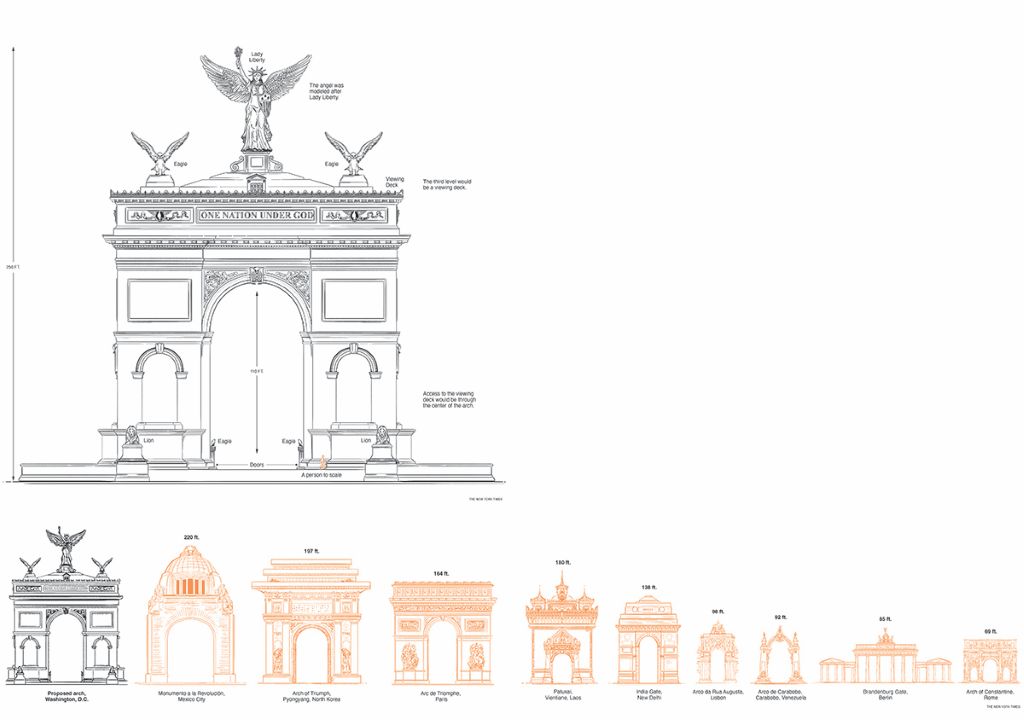
In fact, the arch submitted to the panel would be taller than nearly every other monumental arch across the United States and across the world.
Many of the world’s monumental arches are war memorials, such as India Gate in New Delhi and the Soldiers’ and Sailors’ Memorial Arch in New York City. Some commemorate revolutions, like the Monumento a la Revolución in Mexico City, and others, like the Rua Augusta Arch in Lisbon, Portugal, symbolize the strength of a people.
Who Is the Arch for? ‘Me’ Said Trump
Asked in October whom the proposed Washington arch would be for, Trump responded, “Me.”
If built as the Trump administration planned, the arch would remake Washington’s landscape. Its proposed location means it would be in full view when entering or leaving the capital via the Arlington Memorial Bridge. Its originally proposed height means it would be taller than the Lincoln Memorial and nearly as tall as the U.S. Capitol.
The White House expects to complete construction before the end of Trump’s term. But questions remain on how the arch would be built, including who will pay for it.
It remains possible that, like Trump’s planned 90,000-square-foot White House ballroom, the proposed arch could get caught up in a legal quagmire.
A group of Vietnam War veterans, as well as an architectural historian, have sued in federal court to stop its construction. The lawsuit argues that the arch would require congressional approval under various statutes, including the Commemorative Works Act of 1986, which dictates that a memorial built in the proposed location must be of “preeminent historical and lasting significance to the United States.”
Several congressional Democrats filed an amicus brief in support of that lawsuit in March. Washington, the brief states, “is not the President’s backyard to renovate, relandscape, and build in as he sees fit.”
This article originally appeared in The New York Times.
By Marco Hernandez and Anushka Patil/Anna Rose Layden
c.2026 The New York Times Company
The post How Trump’s Giant Arch Would Compare to Others Across the World appeared first on GV Wire.