

Fresno Has a New Way of Tracking Homelessness. What Do Numbers Show?


Over the past several years, the Fresno Madera Continuum of Care has counted homeless people in the two counties by driving street-by-street and noting the numbers in a single day.
Those counts help agencies get funding and let officials know how effective policies are.
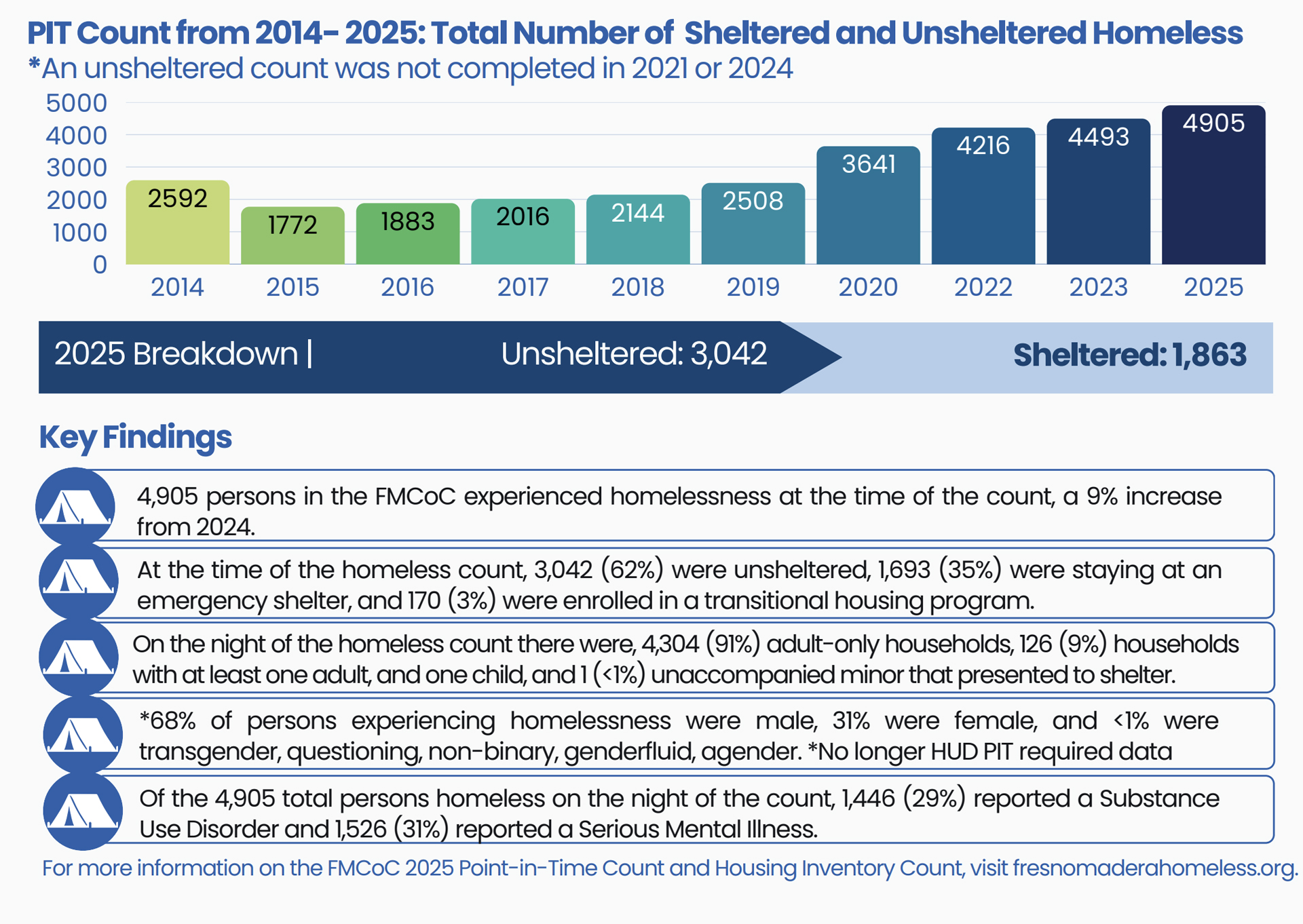
That method, used for the last time in 2025, shows a 9% increase from 2023 in both sheltered and unsheltered housing across the region. This comes as statewide numbers — which have their own flaws — showed declines.
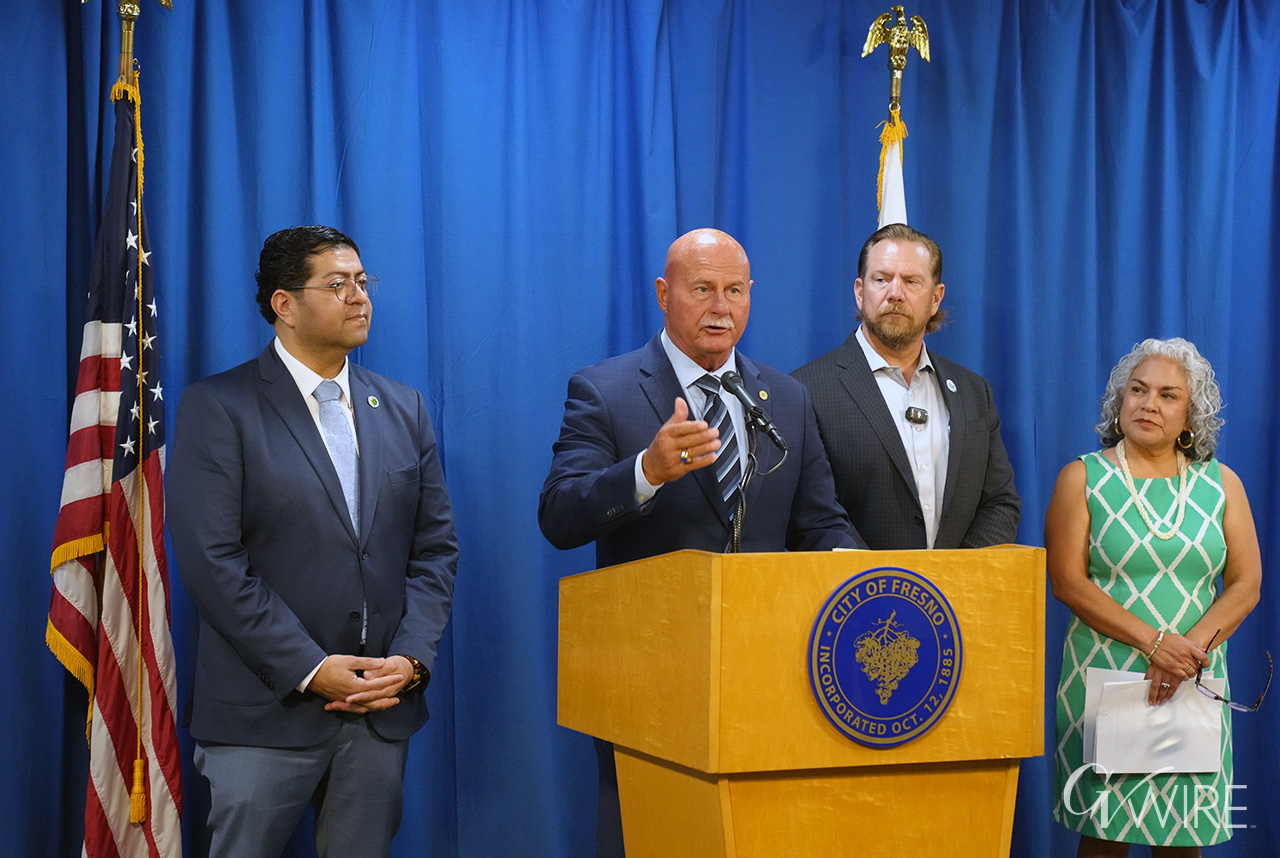
A new methodology introduced in 2026 will be more accurate, Fresno Mayor Jerry Dyer said. Rather than doing a drive-by count, surveyors are meeting with people and asking if they are truly homeless, what caused their homelessness, and where they came from.
Dyer said that the old method more than likely counted people as homeless who were not.
“Folks may have been inadvertently categorized as homeless,” Dyer said. “But based on what we know today, more than likely they were.”
However, under the new method, responses are voluntary. Those who decline to answer are not counted. Preliminary 2026 results show a marked decrease in Fresno and Madera.
Laura Moreno, executive director of the continuum, said while the new count has its limitations, it will be more accurate and give a better picture of the reasons for local homelessness.
“There was a change in the methodology that was brought forward so that we could really look at individuals. So that we weren’t just counting people in terms of numbers,” Moreno said. “But that we know people’s stories.”
Credit Fresno for Helping Get People Off the Streets: Dildine
More than 17 months after submitting 2025 numbers, the U.S. Department of Housing and Urban Development certified results from the Fresno-Madera Point-in-Time Count.
Those results showed the number of people in shelters and on the street rising to 4,905 from 4,493 in 2023. Nearly 1,500 had been homeless for more than year and had a disability, qualifying them as “chronically homeless.” In addition, 1,446 reported a substance use disorder and 1,526 reported having a serious mental illness.
These findings come as the state reported a 2.8% overall decrease in the homeless population. Breaking the numbers down: there was a 6.8% decrease in unsheltered homeless residents and a 5.1% increase in sheltered persons.
State data in 2025 had its own problems.
Neither Sacramento nor San Francisco, two of the state’s biggest metros, submitted Point-in-Time data for 2025.
The Los Angeles Point-in-Time Count came under scrutiny when the RAND Public Policy Institute published a report saying that the metro has been undercounting the homeless population for several years due to a miscount of people living in neither tents nor cars.
The RAND Institute estimated 7,900 people could have been missed in the LA count.
Fresno Mission CEO Matthew Dildine said the city of Fresno’s higher count may be the more accurate than many other metros in the area.
He added that the city should get credit for its efforts as the reasons for homelessness fall outside the powers of a local government.
“The city should be judged on how many people they’ve helped cycle out of homelessness rather than how many more new people need help,” Dildine said.
New Method Paints Clearer Picture of Homelessness: Moreno
The preliminary 2026 numbers show a 33.7% decrease from 2025. That breaks down to 1,619 people who agreed to take the survey saying they were unsheltered. Another 1,635 said they have shelters to live in.
“That to me is the value of this new survey methodology, that we’re right away better understanding the needs of our community and being able to respond more quickly.” — Fresno County Supervisor Luis Chavez
The city of San Francisco this year adopted a similar methodology. The change drew criticism from some homeless advocacy groups, reported the San Francisco Standard.
When that city’s preliminary numbers showed a 22% drop in unsheltered homelessness, accusations of political motivations arose. Those accusations said the city wanted to show its sweeps had been successful, the Standard reported.
Moreno told GV Wire that the decision to change methodology came locally. She said a subcommittee of the 62-member continuum developed the new approach as a way to better understand the reasons for homelessness. Next year, they will develop strategies to address people who don’t want to talk, Moreno said.
Beyond the basic questions, they ask about personal stories, addictions, and mental health. They also ask about domestic violence and where they’re from originally.
Supervisor Luis Chavez said during the news conference that surveyors talked with a couple living in an abandoned vacant lot who had a monthly income but didn’t have enough for a deposit and first-month’s rent. He said they were able to connect that couple with services to help them.
“That to me is the value of this new survey methodology, that we’re right away better understanding the needs of our community and being able to respond more quickly,” Chavez said.
What Will 2027 Bring for Homeless Populations?
Dyer said he’s confident the 2027 count will show even greater decreases. In the upcoming budget, Dyer asked for a second Homeless Assistance Response Team, this time made up of a police officer unit that is able to quickly respond to homeless issues.
When Fresno regained its “ProHousing” designation — awarded by the state for favorable housing policies — in May, it put the city in line for funds from a $800 million pot for housing and homeless services in next year’s budget, Dyer said.
“Not every jurisdiction has it, so they won’t even qualify,” Dyer said. “So I anticipate it’s going to be more funding for the city of Fresno than we have received this last time.”
The last round — which was up in the air until nearly the 11th hour — allocated $500 million to California cities.
Nonprofits Face New Hurdles in Getting People Off the Streets
Facing nonprofits, however, is a shifting economic cycle, wrote Dildine in an op-ed for GV Wire. The service providers that cities and counties turn to for specific, boots-on-the-ground help have seen drastic cuts in grants and giving, Dildine said.
The county of Fresno last week held a public forum to discuss what could be substantially increased social service costs brought on by diminishing revenues and changes in federal funding. The county could be beset by hundreds of millions of dollars more in costs as it has to cover indigent care, along with more food and health benefits.
Transitional beds have are in short supply. Changes in funding and requirements to turn converted hotel beds into permanent housing cut the number of local transitional beds from highs of 840 to just over 700, Dyer said.
Supervisor Nathan Magsig added that Assembly Bill 109, which shifted responsibility of housing for low-level offenders onto local governments, has strained resources. Coupled with policies closing prisons, he said the number of homeless people on probation or parole has climbed.
“Just this morning, I put out some information from our chief probation officer showing that today there are 939 individuals on probation — the equivalent of parole — who are homeless,” Magsig said.
Trump Steers Funding Away from Housing First
Some changes at the federal level, however, have been positive.
For example, Funding for Homeless Assistance Grants rose by $336 million in 2026, according to the National Low Income Housing Coalition.
A change in funding strategy by the Trump administration away from Housing First — which dedicated 90% of HUD funds for housing projects — means money for broader approaches to homeless responses, Dildine said.
One-third of HUD money goes to permanent housing, one-third to services, and one-third to shelters. This allows providers to have money for treatment, recovery programs, and transitional housing, Dildine said.
But aligning with the new policies takes time, Moreno said. For the continuum, that means finding new vendors and service providers.
“We’re having to make the change from what the amount that we have provided for permanent supportive housing and decreasing those beds, which means that probably some of those programs are no longer going to be running,” Moreno said. “We have to transition to something different.”
The post Fresno Has a New Way of Tracking Homelessness. What Do Numbers Show? appeared first on GV Wire.
 Like
0
Like
0
 Dislike
0
Dislike
0
 Love
0
Love
0
 Funny
0
Funny
0
 Wow
0
Wow
0
 Sad
0
Sad
0
 Angry
0
Angry
0







Comments (0)