

America’s Farms Depend More Than Ever on a Troubled Visa Program


HERMISTON, Ore. — In the early months of the year, thousands of men make their way north from Mexico and Central America to tend America’s most delicate crops.
They travel on chartered buses through the night to farms where they spend most of the year picking crops like blueberries and celery, produce still harvested best by human hands.
These are America’s H-2A workers, named for the visa the federal government grants them. The program is uncapped and available to seasonal agricultural employers who can’t find domestic workers. Since 2013, as farmworkers have aged and immigration has slowed, H-2A holders have quadrupled to become a sixth of the agricultural labor force.
The program is poised to grow even faster. As the Trump administration pursues immigrants lacking legal status, it’s becoming harder to find workers, foreign or native-born. And the White House has restricted many avenues for legal immigration, such as refugee status, H-1B visas for skilled workers and any immigrant visas for people from 75 countries.
More Visas, Lower Wages
But farmers pushed back, and the Agriculture Department responded. Last fall, it lowered the wages that guest workers must be paid, substantially decreasing the cost of the program. In the first half of the 2026 fiscal year, the Labor Department approved 17% more visas than in the same period the year before.
In theory, the program is mutually beneficial. Growers get crucial help during the growing season, and foreign workers make far more than they would at home without having to risk sneaking across the border.
Amando Chavez’s sons had been working for AgriLabor, a farm contractor in Oregon, and recommended him for an H-2A position in 2023. He has come every year since. He farms some of his own land in Mexico’s Michoacan state but doesn’t always get the price he would like for his vegetables.
“I come here, I get more money,” Chavez said, in hesitant English, while waiting for orientation before joining the cherry harvest. He never considered coming illegally. Although he won’t earn as much this year with the lower wage rates, he said it was still worth the trip.
The program’s rapid expansion, however, comes with significant risks. H-2A visas have historically been ridden with fraud, labor trafficking and abuse. According to the Government Accountability Office, of the 2,857 investigations that the Labor Department pursued from 2018 to 2023, 84% found violations.
The agriculture industry is trying to police itself and reward good behavior, but the efforts depend on the goodwill of growers and labor contractors, which take up an increasing share of the visas.
“Having workers tied to an employer for their legal status, their wages, working conditions, their ability to return, creates such a power differential that really exacerbates vulnerability to forced labor,” said Rachel Micah-Jones, executive director of the Centro de los Derechos del Migrante, which advocates on behalf of migrant workers.
High Standards, High Costs
Taylor Atkinson’s father got into labor contracting in 1990, supplying the reforestation industry in western Oregon with local workers. As willing hands became harder to find in the 2010s, the pair started a company called AgriLabor to bring in guest workers to cultivate watermelons and corn. Now Atkinson hires about 2,000 workers on H-2A visas each year, serving labor-intensive crops within an hour’s drive of Hermiston, Oregon.
Atkinson, who learned Spanish on a mission trip to Argentina, said he always wanted to operate the business ethically. His first big test was recruiting. In the H-2A program, recruiters often illegally charge workers thousands of dollars in fees for jobs with U.S. growers. In his first season, he advertised a recruiting event in Mexico on Facebook. A busload of workers showed up expecting jobs, having paid about $500 each to a fraudster who stole and modified Atkinson’s ad to lure them in.
“People are trying to scam workers all the time,” Atkinson said. After that, he did the job himself with trusted lieutenants, holding smaller events and advertising through word of mouth.
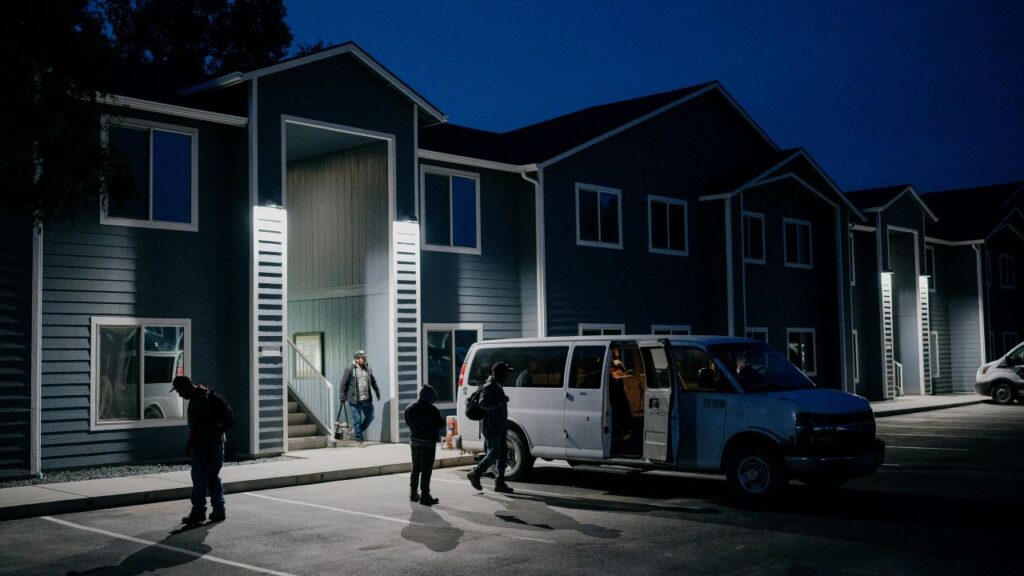
He went through a similar evolution with housing, which employers must provide along with transportation. First, he rented rooms for the growing season. But after one lease fell through at the last minute, he started buying apartment buildings and outfitting them with bunk beds, shared kitchens and air conditioning.
Now AgriLabor is a complex operation. Atkinson has 10 industrial ice machines for supplying cold water and a warehouse full of pruning shears, fruit baskets, first aid kits and shovels. He has a housing maintenance department, 100 portable toilets, 100 vans, 20 school buses and an auto body shop. Since diesel mechanics are hard to find, he brings one in on an H-2A visa.
That level of service is expensive for growers, and they can be tempted by lower-cost competitors. A former employee of Atkinson’s who started his own labor contracting business was charged by the Justice Department this year with underpaying workers and exposing them to pesticides and extreme heat.
Oregon and Washington have enacted labor standards on top of the federal rules, which protect workers and add costs. When the federal Labor Department allowed employers to charge workers for housing, the rule was moot in Washington and California, where the deduction would drop workers below the state minimum wage. There are also heat protection rules and overtime requirements, which most states lack.
Weak Sticks, Missing Carrots
The conditions in the deeply Democratic Pacific Northwest are not universal. In states with looser regulations, there’s little pressure to improve.
Nearly a third of all H-2A workers in 2025 went to Florida, Georgia and North Carolina — states with minimal labor standards and weaker enforcement. In 2021, Georgia’s onion fields were the site of one of the largest labor-trafficking cases in the Labor Department’s history, and North Carolina’s H-2A industry is dominated by a cooperative whose founder went to prison for fraud in 2015.
Caitlin Ryland, managing attorney with the farmworker unit of Legal Aid of North Carolina, said conditions had not improved much since then. H-2A workers are reluctant to complain if they are not being paid properly or their housing isn’t up to code.
“If you’ve got that unending supply where you could have a new crop of workers every single year, I don’t know what the incentives would be to provide shade when it’s not legally required, or provide flush toilets in migrant housing,” Ryland said.
Only 32 Farms Certified for Good Labor Practices
That’s a problem that the Equitable Food Initiative has been trying to solve since 2008, when Costco; Oxfam, an anti-poverty nonprofit; and the United Farm Workers began developing a certification for farms with good labor practices. In 2018, a broader group of retailers, including Walmart, pledged to protect human rights in the produce supply chain.
Some of the retailers pay a bonus to workers at certified farms, amounting to $35 million since the program started. The Equitable Food Initiative, or EFI, says its certified farms are competitive because their employees are treated better and more motivated. But there is little commercial incentive to participate; only 32 U.S. farms have gotten certified.
Matt Rogers started a farm labor contractor called AgSocio after years working as a buyer for Whole Foods. The company is the only contractor to achieve EFI certification. But this year, he folded the company back into its major investor, a large grower. He said buyers were reluctant to pay a premium for his pricier services.
“The market often does not meaningfully reward high-road labor practices,” Rogers said.
Joe Martinez, a former member of the United Farm Workers staff, started CIERTO, a nonprofit recruiting organization, with support from foundations, including Walmart’s. Certification hasn’t helped his sales, either.
“If the retailers don’t come forward and acknowledge it and start to provide a better price incentive, then I don’t see how this scales and becomes a standard business practice,” Martinez said.
A disadvantage for farmworkers is baked into the structure of the H-2A statute, which binds them to a single employer. Michael Clemens, an economist who studies immigration, believes that allowing visa holders to change jobs is the best way to prevent abuse. South Korea, for example, lets workers quit and be rehired.
“Giving workers the opportunity to seek out better employers is so much more effective than any regulatory apparatus,” Clemens said. “Workers have the strongest incentive to make sure their rights are enforced.”
This article originally appeared in The New York Times.
By Lydia DePillis/Grant Hindsley
c.2026 The New York Times Company
The post America’s Farms Depend More Than Ever on a Troubled Visa Program appeared first on GV Wire.
 Like
0
Like
0
 Dislike
0
Dislike
0
 Love
0
Love
0
 Funny
0
Funny
0
 Wow
0
Wow
0
 Sad
0
Sad
0
 Angry
0
Angry
0








Comments (0)