Tennessee Approves New Map Aimed at Flipping the Last Democratic Seat
 QWER
QWER
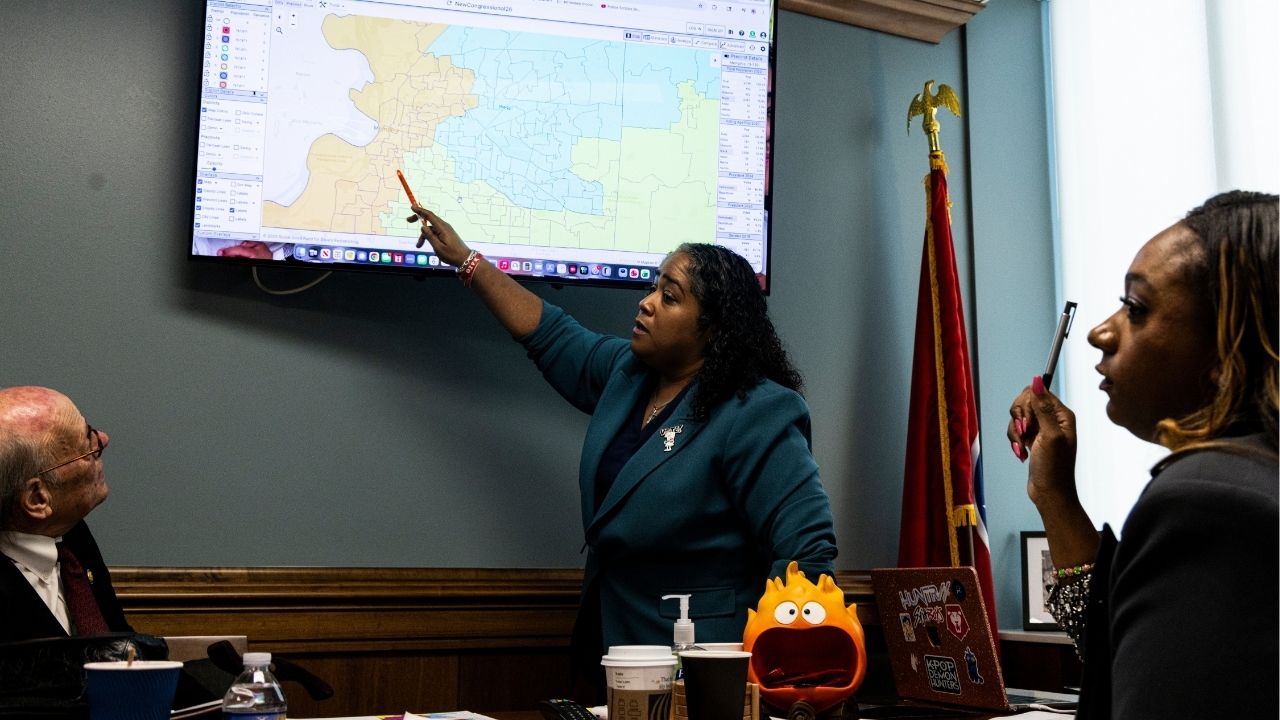
NASHVILLE, Tenn. — The Tennessee General Assembly gave final approval Thursday to a new congressional map that slices up Memphis to scatter Black voters into neighboring districts, a move intended to eliminate the state’s last Democratic House seat.
It is the first map crafted since the Supreme Court weakened the remaining provision of the Voting Rights Act, by making it difficult for states to craft majority-minority districts that would not be considered racial gerrymanders. With Tennessee taking the lead, the ruling has opened a new front, particularly in the South, in a bitter, coast-to-coast redistricting battle ahead of November’s midterm elections.
The new map, passed over angry, loud protests that sought to at least slow the vote, splits Memphis and Shelby County into three separate districts, blasting apart the seat of U.S. Rep. Steve Cohen, Tennessee’s last House Democrat. It also aims to shore up the seat of U.S. Rep. Andy Ogles, a Republican who was facing a well-funded Democratic challenger, by shifting the boundaries around the liberal city of Nashville.

Gov. Bill Lee, a Republican, is expected to sign the bill.
The final vote in the state House exploded into noisy chaos, as Democrats and demonstrators drowned out the final tally with loud noisemakers, yells and alarms. Shortly after, in the state Senate, Republicans faced similar outcries as demonstrators yelled, “hands off Memphis.”
Both chambers passed the map largely along party lines, though two Memphis-area Republicans in the House joined Democrats in opposing the measure.
Tennessee’s primaries are scheduled for Aug. 6. A lawsuit challenging the new map is widely expected.
Leaders of the state legislature, where Republicans hold a supermajority, said they redrew the map based on partisan politics, not race, to comply with the Supreme Court decision.
“It was absolutely drafted on politics,” said state Rep. Jason Zachary, R-Knoxville. The goal, he said, was to have an entirely Republican delegation.
“We’re taking advantage of that as the supermajority in this body,” he said.
Democrats, noting that about two-thirds of Memphis voters are Black, said it was a blatant attack on hard-won gains for fair representation in a state shaped by slavery, segregation and the Civil Rights Movement.
“Perhaps the legislature should explain why Memphis should continue to be part of the state of Tennessee,” said state Rep. Antonio Parkinson, D-Memphis. He suggested that the city should break away from the state.
“You’re constantly beating on us,” he said. “Allow us out.”
Some voting rights experts said the map would be an early test of what the high court now considers a racial gerrymander under what is left of the Voting Rights Act, as well as how voters would challenge new district lines. David Becker, the executive director of the nonpartisan Center for Election Innovation and Research, said the map likely “would never have withstood scrutiny under the Voting Rights Act under the last several decades.”
“Now, the Supreme Court almost seems to invite it,” he added.
Triggered last summer by President Donald Trump’s demand that Texas embark on a rare mid-decade redistricting, half a dozen states across the country had already created new maps in a tit-for-tat redistricting war. Republicans are poised to take the lead in that race, although their chances of maintaining control of the House next year remain precarious.
Louisiana, whose congressional map was at the center of the Supreme Court case, is expected to draft new district lines that undercut at least one majority-Black district. Other Southern states, including Georgia and Mississippi, have signaled they will make similar moves after the 2026 midterm elections.
The votes Thursday capped off a raucous, emotional three days at the Tennessee Capitol in Nashville, after Lee summoned lawmakers for a special session. Trump said he spoke with Lee about a new map, and the redistricting effort was closely watched in Washington and across Tennessee.
To take up the new map, Republicans also pushed through a bill that repealed a ban on redistricting in the middle of a decade.
Republicans repeatedly stressed that their intent was driven by partisan politics and population, not race, since the Supreme Court has made clear it does not see a role for the courts in blocking maps drawn purely for political gain.
One Memphis Republican, state Rep. Mark White, said in an interview that he voted against the bill because “I hear and I listen and today was not a day for me to vote yes.”
“If I lose the respect of my Black community or the respect of the white community, then I can’t make change,” he said.
Democrats pointed to judicial precedents that prevented changes too close to a primary election, highlighting how Black voters had repeatedly been the driving force behind political decisions in Memphis.
Drawn just three months ahead of Tennessee’s primaries, the new maps scrambled political campaigns and calculations. Some candidates, when asked this week, said they would still run, even if it wasn’t entirely clear what district they would pick. And the stiff political headwinds facing Republicans this year could tamp down the scope of the new Republican margins.
Even so, the districts were drawn to give Republicans an overwhelming advantage, even in a tough political year.
—
This article originally appeared in The New York Times.
By Emily Cochrane/Brad J. Vest
c. 2026 The New York Times Company
The post Tennessee Approves New Map Aimed at Flipping the Last Democratic Seat appeared first on GV Wire.