

Some Tulare County Farmers Pumping Water Like It’s the ‘Wild West’


Some farmers in southern Tulare County – where excessive groundwater pumping has already caused hundreds of millions in damage to the Friant-Kern Canal – are back to pumping like crazy while there’s a gap in oversight.
It hasn’t gone unnoticed.
“They have got to be serious about stopping the pumping,” said Jeevan Muhar, general manager of Arvin-Edison Water Storage District Groundwater Sustainability Agency.

“It needs to stop for the (Friant-Kern) Canal to function as it is supposed to.”
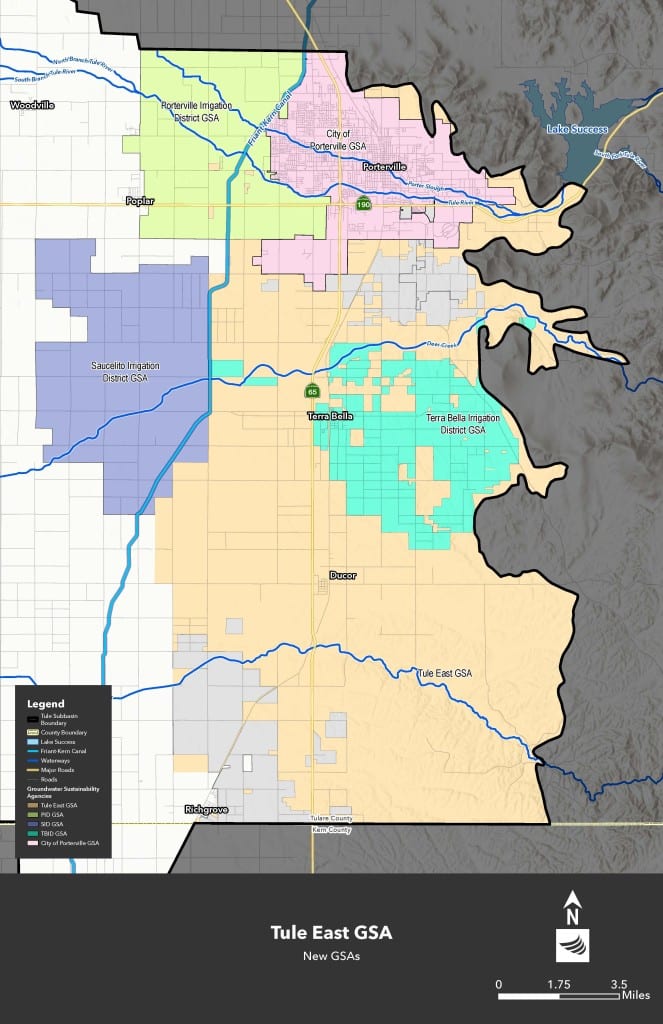
The “they” Muhar referred to is the Tule East Groundwater Sustainability Agency (GSA), which took over a large chunk of the Tule subbasin after its predecessor, Eastern Tule GSA, folded.
But there’s not much that can be done right now as Tule East is still in its formation stages.
“We have no rules and no way of making rules,” said Mike George, Tule East GSA board president. “It’s a real problem. We have taken a giant step backwards this year because of the situation we find ourselves in. We don’t want to have this issue of the ‘wild west’ going into the next water year.”
Local grower Andrew Hart said recovering from this unregulated period will be a “heavy lift.”
“We are losing ground in the time that it will take to get back to where we were,” he said.
Action can’t come soon enough for managers who rely on the Friant-Kern Canal to bring surface water to their districts, especially those south of Tule East. A 33-mile section of the canal through Tule East sank so much from excessive pumping that its carrying capacity was cut by 60%.

“Tule East has the ability to show it means business,” said Eric R. Quinley, general manager of Delano-Earlimart Irrigation District GSA. “Allowing another year or two of overdraft pumping is not an acceptable outcome.”
Hart said most growers want to do their part, but the situation is “just a function of reality.”
“You play by the rules you’re given and when these are the rules, this is how you play. I’m hoping that it will all be rectified as soon as it can be.”
Tule East just became an official GSA in February, picking up the mostly groundwater dependent lands leftover from Eastern Tule, which collapsed after the region was placed on probation by the Water Resources Control Board in 2024. Alarming rates of subsidence and Eastern Tule’s “questionable” groundwater accounting policies were major factors in the board’s decision.
Under probation, growers are required to meter and register their wells at $300 each, report extractions and pay $20 per acre foot pumped to the state for oversight costs. The reporting requirement kicked in May 1 and growers can expect invoices from the state soon.
Frenzied Pumping Is on Friant Water Authority’s Radar
Meanwhile, the ramped up pumping in Tule East GSA also caught the attention of the Friant Water Authority, which spent more than $326 million to rebuild just 10 miles of the sagging Friant-Kern Canal.

“Since we don’t live in a perfect world, we will not wait around hoping for a miracle.” — Johnny Amaral, CEO of Friant Water Authority, addressing excessive groundwater pumping that could further damage the Friant-Kern Canal
Friant and Arvin-Edison recently settled several lawsuits against the old Eastern Tule GSA and some of its member districts for enacting policies they said exacerbated the damage.
Johnny Amaral, Friant’s CEO, wrote in a text that he hoped farmers would act with reason to make sure the canal wasn’t further damaged.
“Since we don’t live in a perfect world, we will not wait around hoping for a miracle,” he said.
At Tule East’s June 3 board meeting, Hart asked if the board could enforce pumping limits from Eastern Tule’s 2022 groundwater plan, which was rejected by the Water Board for not doing enough to slow subsidence.
Even so, it did have some pumping limitations, Hart noted.
Tule East’s attorney, Lauren Layne, said that was not legally possible. The GSA will have to adopt its own, new pumping policies.
Hope Is That State Fees Will Reduce Pumping
There was some hope the state fees would help rein in the excessive pumping.
“(Landowners) haven’t gotten those invoices yet, but they’re not small,” Layne said during the meeting.
George said landowners are caught in the middle, trying to hold on to some of their farming investments while bracing for a ‘brutal’ future of significantly constrained water supplies.
“A lot of growers see what’s going on and see the handwriting on the wall. And there are others who will milk every drop until someone makes them stop.”
About the Reporter
SJV Water Reporter Lisa McEwen grew up in Tulare County. She has reported on agriculture and other issues for a wide variety of publications, including, Ag Alert, Visalia Times-Delta, the Fresno Bee and the Tulare and Kings counties farm bureau publications.
About SJV Water
SJV Water is an independent, nonprofit news site covering water in the San Joaquin Valley, www.sjvwater.org. Email us at sjvwater@sjvwater.org.
The post Some Tulare County Farmers Pumping Water Like It’s the ‘Wild West’ appeared first on GV Wire.
 Like
0
Like
0
 Dislike
0
Dislike
0
 Love
0
Love
0
 Funny
0
Funny
0
 Wow
0
Wow
0
 Sad
0
Sad
0
 Angry
0
Angry
0








Comments (0)