Misty Her Went Into a Fresno Unified Classroom. Did She Unlock the Keys to Reading?
 QWER
QWER
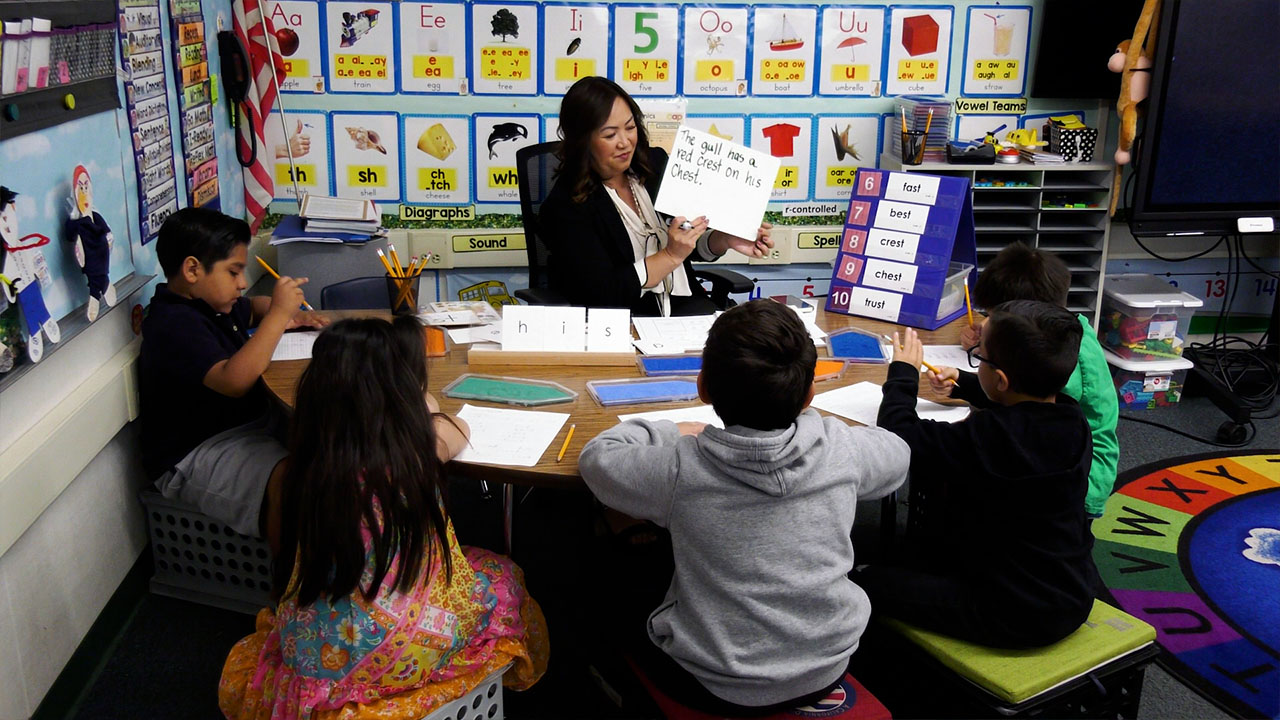
Fresno Unified Superintendent Misty Her believes she knows what it takes to get young students reading at grade level.
That’s because the superintendent has gotten out of the office and into the classroom on Mondays since the start of that school year. Working alongside first-grade teacher Ana Bustos at Mayfair Elementary School, their students have made impressive gains in early literacy.
Now, the district is tasked with spreading this magic to every elementary school classroom.

“I believe that a superintendent should be in the classroom,” Her told GV Wire. “It’s taught me a lot about the system that we’re creating for our teachers. … It’s allowed me to have conversations with my team, to go, hey, I think we need to make these changes. We need to make these tweaks.”
The Fresno Teachers Association has often criticized district administration for making decisions from downtown, away from the classroom.
Her is setting a new precedent, working alongside teachers and getting into the nitty-gritty of education.
“All administrators would benefit from doing what she did, which was not make decisions just from downtown through cabinet meetings with data,” Bustos told GV Wire. “But to actually come to the classroom and see what is really happening firsthand.”
FTA President Manuel Bonilla did not respond to multiple requests for comment.
Superintendent and Teacher Achieve Huge Success With Students
The superintendent and a small group of students settle around a table tucked into the corner of a Mayfair Elementary classroom — a spot she has occupied every Monday morning since August.
Her’s time is spent on building literacy, focusing on those students struggling to keep up with their classmates.
The extra support has paid big dividends: 84% of students are reading at or above grade level.
At the beginning of the school year, more than half of the students in Bustos classroom were behind and in need of intervention.
The group of 13 students was split into two intervention groups, which Her helped teach.
“(She) asked to work with the most struggling students,” Bustos said. “She didn’t say give me the top reading group. She said, let me work with those students that struggle the most.”
At the beginning, only four students were in the “green” and reading at grade level. Now, 20 students have reached this benchmark. And a few are at a second-grade reading level.
One student that Her taught went from reading just four words to reading 144.
The few still struggling to reach grade level are dealing with outside issues, such as behavioral problems, chronic absenteeism, or a learning disability, Bustos said.
The Learning Process
So, what are some of the techniques that are enabling students to read at grade level?
First, the superintendent introduces a new sound such as “st.” The students repeat the sound multiple times, adjusting to the new mouth movement.
Next, Her places letters alongside the new sound, creating a word. On that day, “st” becomes “list,” and fast and chest.
Here comes the fun part, students focus on blending those sounds together to properly pronounce the word. Her aids the students in this endeavor, clearly pronouncing each sound.
As a helpful trick, she also has the students stick out an arm which they can pat down as a new sound arises. The movement helps combine visual, auditory, and kinesthetic learning.
“They’re sitting for a long time, so it gets them moving. And it allows them to visually see (the sounds). So, when I say the word ‘has’ we’ll say ‘ha, as, has,’ ” Her said, tapping her arm with each new sound. “You know each tap that you make stands for a sound. And when you do this, you’re putting it together.”
The students take those sounds and transfer them into writing — spelling the word with a pencil, in the air, or even in sand. As the students’ spell, they continue sounding out the word, connecting the two concepts in their minds.
Once students have that foundation, Her adds the word to a sentence. This places the word in a larger context, teaching students how to position words together to convey an idea or paint a picture.
“The sounds and the words don’t ever work in isolation. And that’s why you do this sentence with them,” Her explained. “We started with very simple sentences. Now, we’re going into more complex sentences with them.”
This is the Orton-Gillingham method, which was specifically designed to help struggling readers through a multi-sensory approach. The district is training all teachers on how to use the method.
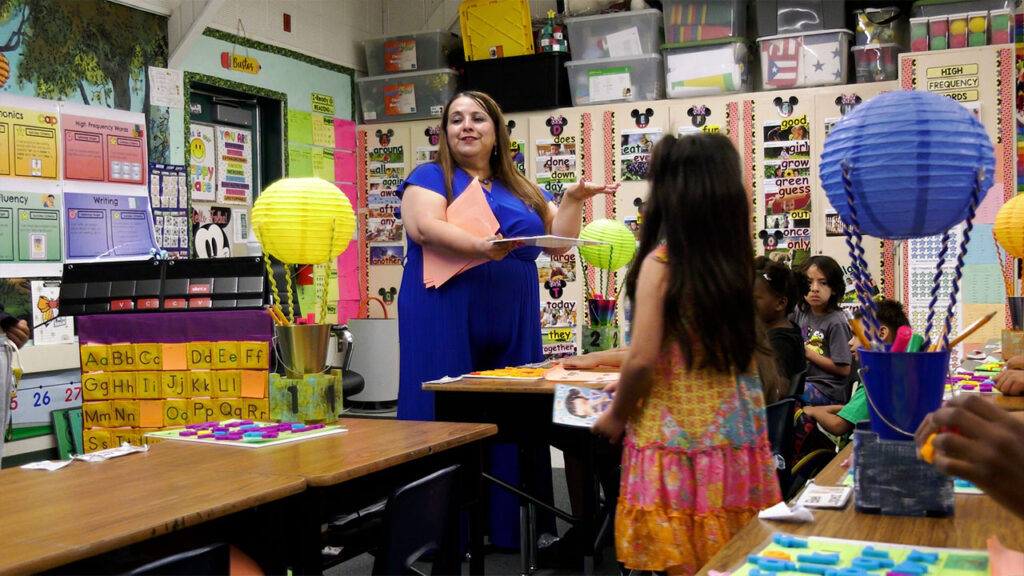
Fresno Unified Works to Improve Literacy
Fresno Unified has centered operations, investments, and efforts around four goals and guardrails, including two goals focused on early literacy.
Historically, the district has failed to reach state averages in English Language Arts performance. In the 2024-25 school year, About 37% of the students tested met or exceeded standards in English Language Arts. Comparatively, 49% of students in California met or exceeded standards.
“I will be the first to say that our academic gains have been minimal. Actually, dismal to say the least,” Her told the School Board early last year.
Now, the district is aiming to have 80% of first grade students proficient in literacy — a goal Her and Bustos have already reached.
“Our class made it four years ahead of schedule,” Bustos said. “If you can instill that culture in your team of high expectations, then you are going to get results.”
To aid in this endeavor, the district has established an interim goal around positioning students to read at grade level.
Last school year, most schools were not on track to reach the interim goal.
In response, the district created an action plan — implementing training, coaching cycles, and data reviews.
Fresno Unified has zeroed in on literacy, because reading is essential in all subjects, including math and science.
“A lot of the math standards require students to learn how to read. And so if we can’t get kids to read it’s going to be really difficult when they get to math,” Her explained. “We are really trying to get everyone to understand that you don’t do lessons in isolation.”
Monitoring is Key to Targeted Improvement
The superintendent has made a large push to identify what is working in schools, classrooms, and programs.
That same emphasis on monitoring was brought into the Mayfair classroom.
“(Bustos) sends me the data on a regular basis. I know exactly what my students are lacking,” Her said, “I’m very familiar with, OK, this student last time was struggling with this. And so when I work with the student, I’m going to watch for that.”
Bustos and Her look at the data together, noting improvements and gaps. This is done on an individual basis, addressing all students.
Classrooms use multiple assessment tools, including iReady and Dibles, to track progress. Additionally, Her checks on students’ work at the end of each lesson to determine their understanding.
“The progress monitoring is everything because when you don’t do progress monitoring you don’t know,” Her said. “When I come in, I know exactly what they’re struggling with, and I know exactly what I need to work with them on.”
Close monitoring is also essential in noticing potential learning disabilities, leading to testing and identification. Early intervention is shown to be more effective, allowing students to keep pace.
Meanwhile, Bustos can continue lessons, advancing the students who are on track.
Alongside them, an aide, who rotates between classrooms, comes in to work on specific skills with another small group.
Small group learning has been proven to be beneficial in targeted growth, strengthening communication, and improving assessment efficiency — something crucial for those falling behind.
Teachers Collaborate to Pass Down Knowledge
Earlier this year, Fresno Unified trustees approved an early retirement incentive to save money amidst the district’s massive budget deficit.
The incentive pushed 573 employees to retire early, causing many to raise concerns about losing teachers with more experience and the creation of a knowledge gap.
Addressing those concerns, the district has worked to help new teachers learn from established teachers, such as Bustos.
“That training is going to be really important for us next year, especially with the new group of teachers,” Her told GV Wire. “Early learning, professional learning is going to be really critical.”
Her went through training herself — learning the Orton-Gillingham method from scratch. The superintendent credits Bustos for guiding her and allowing her to make mistakes along the way. Now, she has become an expert in the program, able to smoothly and effectively lead the small group through a lesson.
“What was important for me was to come and learn. This has been a really learning year,” the superintendent said. “Watching her, how does she do it? And then doing the program with her.”
Additionally, teachers constantly collaborate with their colleagues, meeting with those teaching the same grade. The team shares best practices, struggles, and constant data updates, setting high standards for one another, Bustos said.
“You’re able to create systems where, regardless of anybody retiring or leaving, the team continues the work,” Bustos said. “You should continue to see results even when somebody leaves.”
The post Misty Her Went Into a Fresno Unified Classroom. Did She Unlock the Keys to Reading? appeared first on GV Wire.