

Iran Inflation Is So Bad That Shoppers Buy Food on Installment Plans


In the span of a year, the share of household income that Ehsan, a worker at a textile company in Tehran, Iran’s capital, and his wife, Fariba, a homemaker, spend on feeding themselves and their 10-year-old daughter has doubled. Now, 30% to 40% percent of Ehsan’s salary goes toward food, they said.
Each trip to the grocery store for Ehsan, 44, and Fariba, 42, is laden with stress as they weigh how much they can afford. They have cut down on sweets and cooking oil, and saffron, an essential spice in many Iranian dishes. Unrelenting price increases have made it difficult for millions of Iranians to buy basic necessities.
In interviews over recent weeks with analysts and Iranians, most of whom asked to be identified only by their first names for fear of retribution from authorities, they described replacing lamb and beef with lentils, using buy-now-pay-later apps to procure basics like bread and shampoo, and forgoing medical care.
‘Harder We Work, the Less We Get’
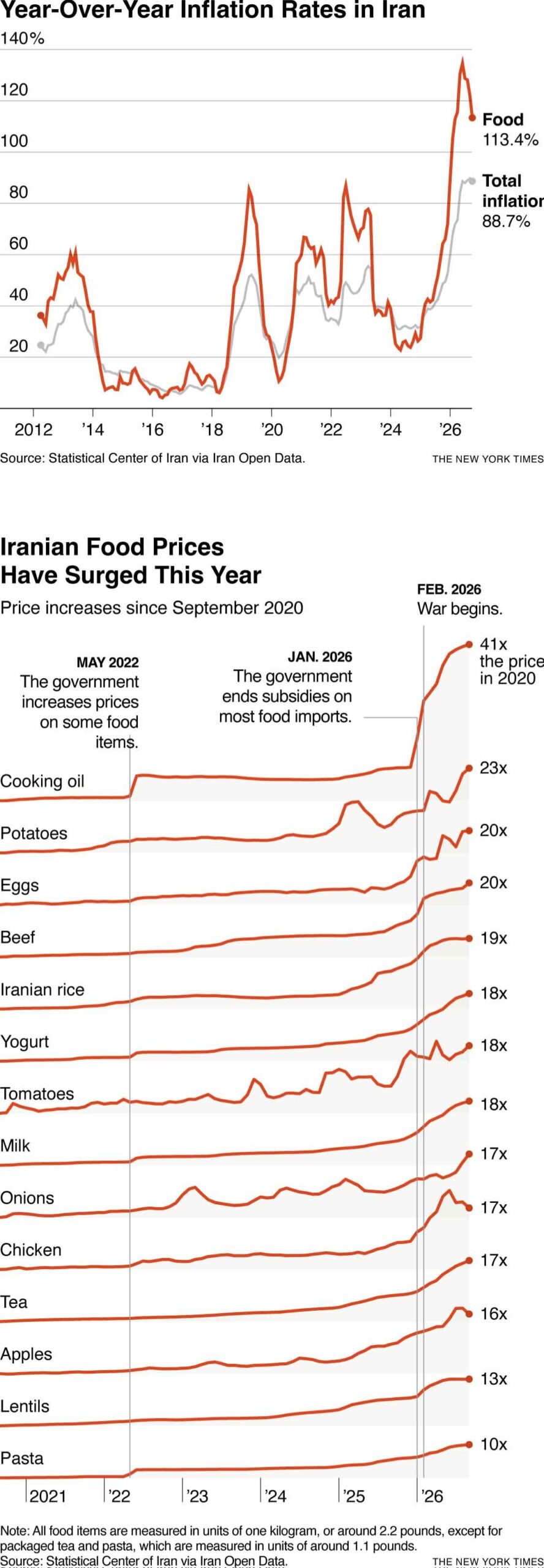
The price of staple goods has soared over the years because of the vise of Western sanctions and mismanagement of the Iranian economy. This year, the dual shocks of the U.S.-Israeli war on Iran and the Trump administration’s economic pressure campaign against the country sent prices to new highs. Some staples cost 10 to 40 times more than they did six years ago, according to government data.
The toll for Iranians is visible on the streets of Tehran, where billboards advertise to consumers that they can now buy daily goods in installments.
“The harder we work, the less we seem to get in return,” said Shahrzad, 28, a teacher in the western city of Ahvaz. “The amount of food we can put on the table keeps shrinking day by day.”
Shahrzad said that when she can afford meat and fruit, she carries her shopping in a black plastic bag because she is embarrassed to let others see her with what have effectively become luxury items.
Shoppers who used to buy 10, 20 or 30 eggs now get two or four at a time.
Double-Digit Inflation Since 2018
Iranians have been contending with double-digit inflation since at least 2018, according to data published by the World Bank. But this year, the phenomenon gathered new momentum.
In Iran, the official year-on-year inflation rate reached 89.8% in September and eased only slightly last month, to 88.7%, according to government data.
While food prices have risen globally, the spike in Iran has been exceptionally steep. In the United States last month, prices rose about 3% compared with a year ago. In Iran, they have more than doubled.
The U.S. naval blockade imposed on Iran during the war has caused trade disruption, but it has largely not affected the availability of food. Choking off Iran’s ability to sell oil, however, has meant that the country brings in far less hard currency, like dollars or euros. That has made it more difficult for businesses to import goods, according to Javad Nazari, a market analyst in Tehran.
Iran’s currency, the rial, has also plunged more than 60% in value against the dollar over the past 12 months, making the cost of buying foreign currency or goods more expensive.
“Fewer dollars come in, so every importer pays more for the ones that do,” Nazari said.
Iran Prints Money to Cover Budget Deficits
Analysts and even some government officials have also pointed to economic mismanagement for fueling inflation, especially the Iranian central bank’s practice of printing money to help cover budget deficits. In August, a senior Iranian official blamed that practice for much of the country’s inflation.
As prices have skyrocketed, wages have not kept up. Around this time last year, a kilogram of beef (about 2.2 pounds) cost 7% of a minimum-wage earner’s monthly salary, according to government data. By last month, that had risen to more than 11% percent. The price of cooking oil has quadrupled in a year, while tea, chicken, yogurt, tomatoes and onions have more than doubled in price.
“Many Iranians can no longer afford a lot of food items, so we eat very simple meals,” said Zahra, 23, a student in Tehran.
Paying for luxuries or even relatively inexpensive items, like a cup of coffee at a cafe, has become difficult. Some are delaying medical care for fear it could wreck their finances.
“Healthcare costs have become so high that we prefer to avoid going to clinics or hospitals for as long as possible,” Zahra said.
Prescriptions Double in Price
Data published by Iranian pharmaceutical companies and analyzed by The New York Times show that hundreds of commonly used drugs have roughly doubled in price, including painkillers and diabetes medication.
As of September, more than 40 pharmaceutical facilities and related businesses had been damaged during the war, Iranian state media reported. But Mehdi Pirsalehi, the head of Iran’s Food and Drug Administration, has also acknowledged long-standing economic problems, including sanctions and the naval blockade, as major factors in price increases and shortages.
The grinding pressure of inflation has forced many Iranians to rethink their lives. Dreams of purchasing a home or car are long gone for many. Marrying or having children is being delayed or given up. Even emigrating in pursuit of a better life can be out of reach as the money for flights, visa fees and exams becomes impossible to save.
Reyhaneh, 30, is an unemployed teacher who lives in Mashhad, a city in northeast Iran. She said her father’s monthly pension was so paltry compared with his expenses that it ran out by the middle of the month. She closely keeps track of how much meat and chicken her household has left in the refrigerator to make sure it lasts.
“We’re surviving, and we try to hold on to the meaningful parts of life and preserve some sense of dignity and humanity,” she said. “But practically speaking, it feels as if so many doors have been closed to us.”
Methodology
Drug price increases shown in this article are based on public disclosures by seven companies published on the website Codal, Iran’s official regulatory disclosure platform for listed companies. Each drug has been categorized according to the World Health Organization’s Anatomical Therapeutic Chemical classification system. The chart shows the 10 most commonly supplied categories of drugs between March 2024 and March 2025, as reported by Iran’s Food and Drug Administration.
Data for all food prices is through September. Prices from September 2025 and September 2026 are represented in the graphic showing the cost of a basket of food.
—
This article originally appeared in The New York Times.
By Yeganeh Torbati, Adina Renner, Shirin Hakim and Sanam Maher/Arash Khamooshi
c.2026 The New York Times Company
The post Iran Inflation Is So Bad That Shoppers Buy Food on Installment Plans appeared first on GV Wire.
 Like
0
 Dislike
0
 Love
0
 Funny
0
 Wow
0
 Sad
0
 Angry
0




Comments (0)