Fresno Council Hopes Red Light Cameras Will Eliminate Driving Deaths
 QWER
QWER
Even in his office in Los Angeles, Damian Kevitt knows how dangerous Fresno can be for pedestrians and cyclists.
“Fresno’s known, at least in the road safety community, for its bad intersections,” said Kevitt, executive director of Streets Are For Everyone. “I’m in Los Angeles and I know how bad the intersections are in Fresno.”
Now, the city of Fresno has a plan to not just reduce traffic deaths but eliminate them altogether.

The “Vision Zero” proposal is set for a vote Thursday, May 21 at the Fresno City Council and it includes many different safety measures.
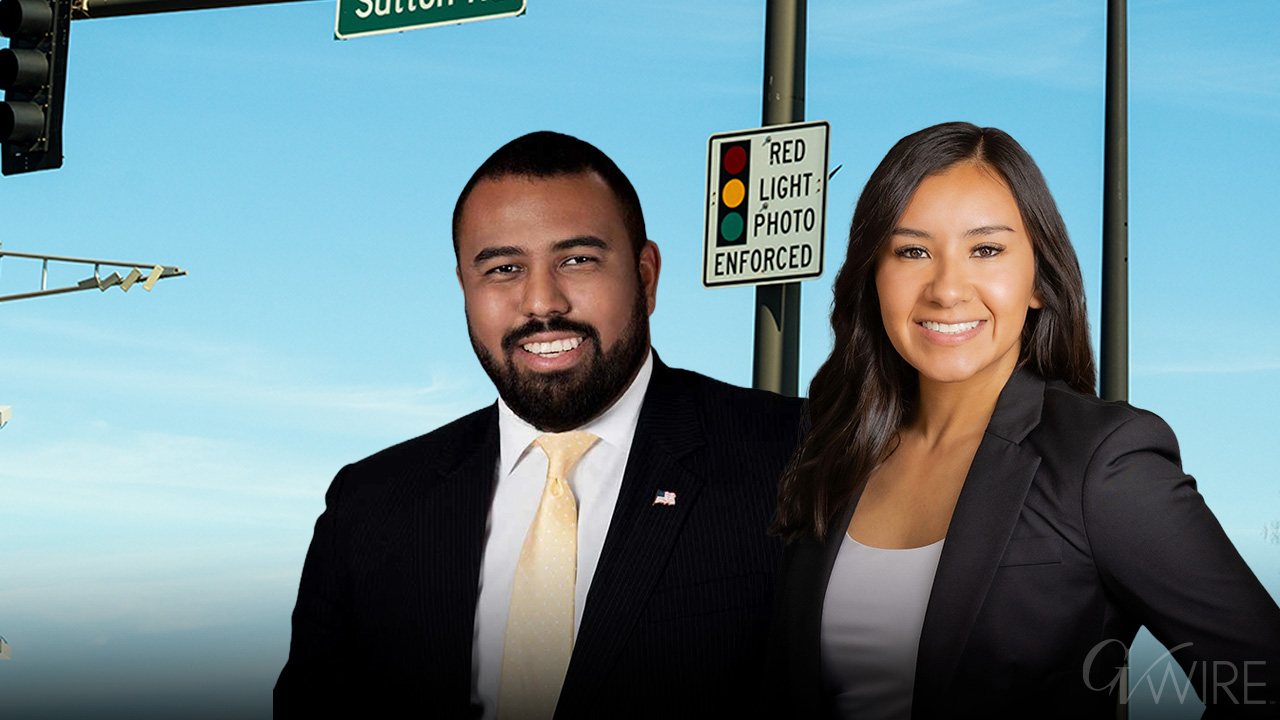
In addition, city councilmembers Nelson Esparza and Annalisa Perea want to reintroduce red light cameras later this year. They plan to introduce a law crafted by Kevitt’s nonprofit. He says it will be far more effective at reducing traffic deaths than the red-light cameras Fresno had in the 1990s.
“This new one is much, much better, and much more reasonable. At the same time, it will be a deterrent and should actually make those intersections safer,” Kevitt said.
City Trying to Change Driver Behavior
The Vision Zero plan identifies a series of fixes to Fresno streets to reduce traffic fatalities to zero. Those include sidewalks, crosswalks, better visibility, fewer driving lanes, and cameras.
Esparza said while not a “silver bullet,” the cameras would be part of a solution to reduce traffic deaths in the city. He said he and Perea want to bring the program back before they leave office at the end of the year.
“This is all over the city, but it’s impacting some areas disproportionately. There’s some pretty poor drivers out here, there are also just basic design flaws. …” Esparza said. “Just given the rate of traffic incidents and looking at some of these dangerous intersections that touch District 7, this is something we’ve got to prioritize and turn our attention to.”
Though the city canceled its red-light camera program in 2005, Perea said cameras could change the way drivers travel. She said the city has a speeding and red-light running epidemic caused in large part by distracted and reckless drivers.
She said even though the city has actively made crosswalks more visible and put up speeding cameras, those upgrades only go so far.
“There’s a number of investments that we’re making citywide right now to increase both pedestrian and bicyclist safety, but what it comes to is, we can we make all the investments in the world, but it’s really hard to change driver behavior,” Perea said.
Fresno Ranks High for Dangerous Drivers
Between 2019 and 2023, the city had 217 fatal crashes and 629 severe injury crashes, according to city data.
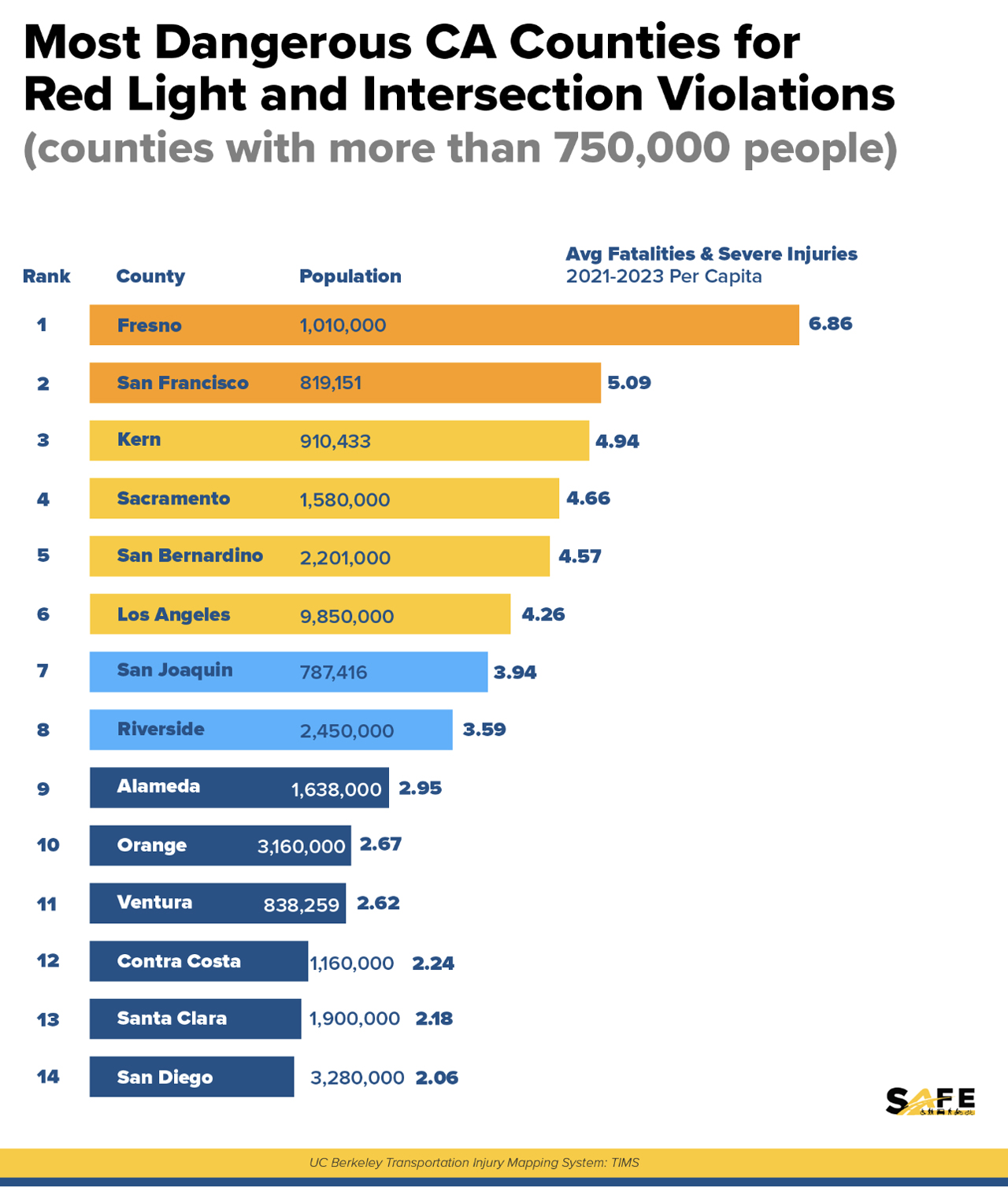
In 2025, transportation advocacy organization Smart Growth America ranked Fresno as No. 7 most dangerous metro in the nation for traffic. Streets Are For Everyone ranked Fresno County as the most dangerous large California county with 6.86 average fatalities or severe injuries per capita.
At the April 23 Fresno City Council meeting, Fresno engineer Andreina Aguilar said 89% of all fatal and severe injury crashes happen at 14% of road networks.
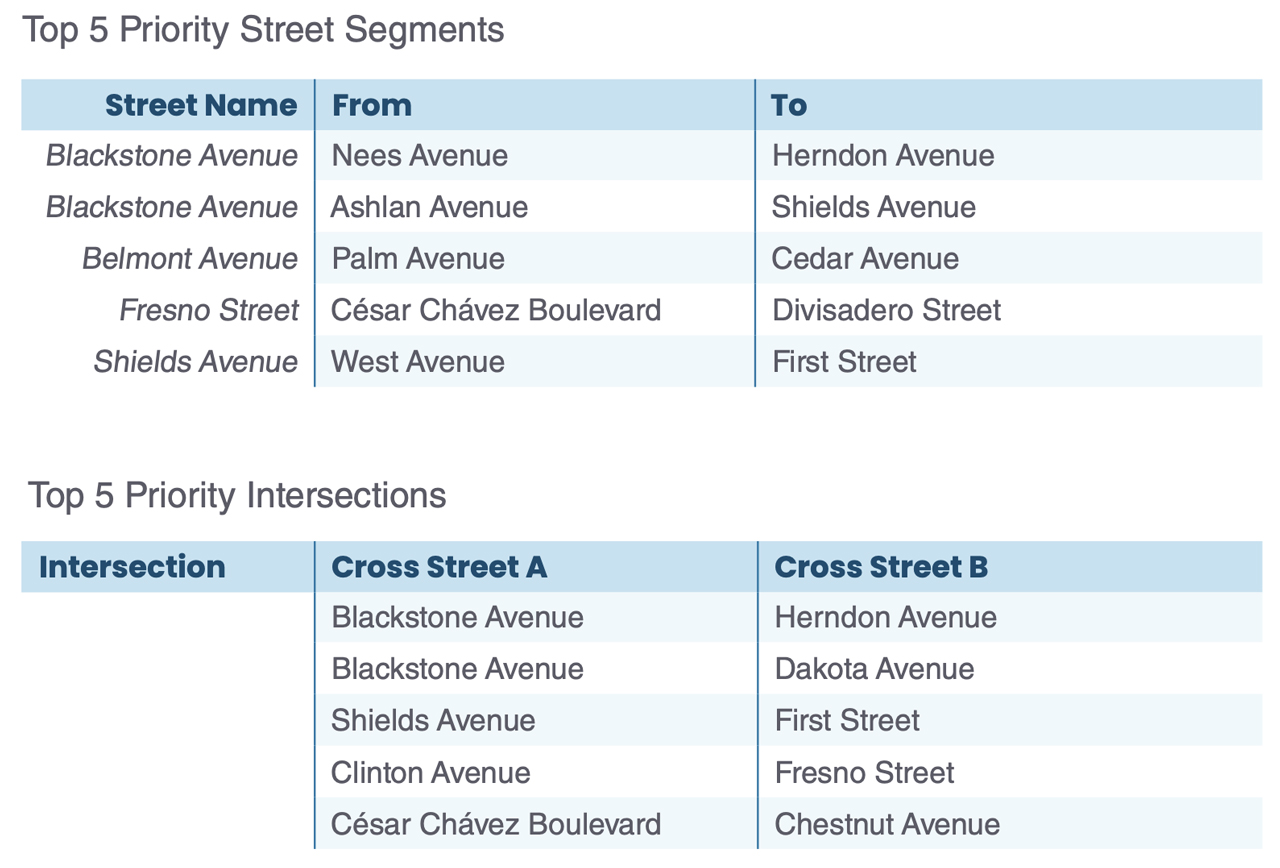
By targeting key intersections, Aguilar said Fresno could drastically reduce traffic deaths. Stretches of Blackstone Avenue from Nees to Herndon avenues and from Ashlan to Shields avenues have high injury rates. Intersections at Shields and First avenues, and Clinton Avenue and Fresno Street also have high collision rates.
One intersection that bothers Esparza and Perea is Clinton and Van Ness avenues, Esparza said.
“There’s constant activity there,” Esparza said. “You see the data, you hear it from the neighbors.”
Without a protected left-turn lane there, Perea said many of the accidents come from people trying to beat oncoming traffic. Soon, the city will install a left-turn light.
SB 720 Fixes Problems of the Past: Kevitt
Planning for the program is in the early stages, Perea said. It would begin with a pilot to see how effectively the cameras reduce collisions. Fines also need to be determined.
Perea said staff is looking at costs to implement the program.
Fresno for years had a red-light camera program that it ended in 2005 because the system wasn’t effective and did not bring in the promised revenue.
Esparza and Perea want to use Senate Bill 720, written in part by Kevitt’s nonprofit.
Unlike the other law — which Kevitt called “horrible” — SB 720 is enforceable, he said. He said pictures don’t need the driver, only the license plate. Fines are capped, starting at $100 and escalating to $500 with repeat violations.
Appealing a ticket costs $25.
Revenue can also only be used on safety upgrades. These include bike lanes, curb extensions, speed bumps, crosswalks, median islands, and a handful of others.
Once violations drop below a designated threshold, Kevitt said cameras must be discontinued.
Cameras can also only be put on the worst intersections and for the first six months of the program, only warning notices are issued.
Red lights have to meet updated minimums.
Perea said putting up red light cameras also requires a public notice process.
“If someone talks about the red light camera program, like how terrible it is, just realize that’s the old one and it is horrible and we don’t support it,” Kevitt said. “It was bad. It’s still bad.”
Extended Yellow Light a Highly Effective Safety Measure
Jay Beeber, executive director of policy with the National Motorists Association, is an outspoken critic of red light cameras. He says cities too often use them as revenue generating schemes.
In 2001, courts and the California State Auditor found the city of San Diego had given control of the cameras and enforcement over to its camera operator.
The operator exploited shortened yellow lights to issue more tickets, the San Diego Tribune reported.
SB 720 requires that cities keep yellow lights at the minimum required length of time.
Esparza and Perea disputed that the cameras would be used as revenue generators. Esparza said cities don’t generally make much money and under SB 720 revenue is directed to safety measures.
Beeber also said when cities contemplate change, they don’t often look at pedestrian or bicyclists being at fault.
Under California’s Freedom to Walk Act (Assembly Bill 2147) jaywalking in most situations is legal.
With heavy concentrations of red-light running at certain intersections, Beeber said the problem is more likely to be the intersection, whether that be visibility or the length of the yellow light.
“If you have an intersection that has a lot of red-light running collisions, you have an engineering problem, you don’t have a scofflaw problem,” Beeber said. “People don’t pick a particular intersection to run reds like that.”
Studies show that lengthening the yellow light to match the actual speed of traffic — rather than the posted speed limit — also significantly lowers traffic accidents.
IIHS Data Show Red Light Camera Effectiveness
The presence of red-light cameras tends to increase rear-end collisions, data shows.
However, considering the trade-off with more dangerous collisions, Wen Hu, senior research transportation engineer with the Insurance Institute for Highway Safety, said the trade-off is worth it.
The IIHS has published many studies showing that red-light running decreases at intersections with cameras. Along with that, injuries and fatalities decreased.
In Arlington, Virginia, a 2010 study shows odds of red-light violations decreased 39% for people who ran a light by less than 1.5 seconds after a camera was installed. More importantly, the rate of red-light running fell 86% for people who ran the light by 1.5 seconds or more. It’s those late red-light runners who are the most dangerous.
A 2017 widely refenced study of large cities shows a 21% decrease of fatal red-light running crashes and a 14% decrease of all types of fatal crashes at intersections with cameras.
Hu told GV Wire data show that cameras can change driver behavior.
“The most effective way to make the drivers follow these traffic rules is the enforcement, where if the drivers know that there’s a 24-7 red-light safety camera at this intersection, they will change their behavior,” Hu said.
The post Fresno Council Hopes Red Light Cameras Will Eliminate Driving Deaths appeared first on GV Wire.