Federal Judge Who Doubles as George Washington University Lecturer Recuses Herself From Antisemitism Case Against the School After Arguing There Was No Conflict of Interest
 QWER
QWER
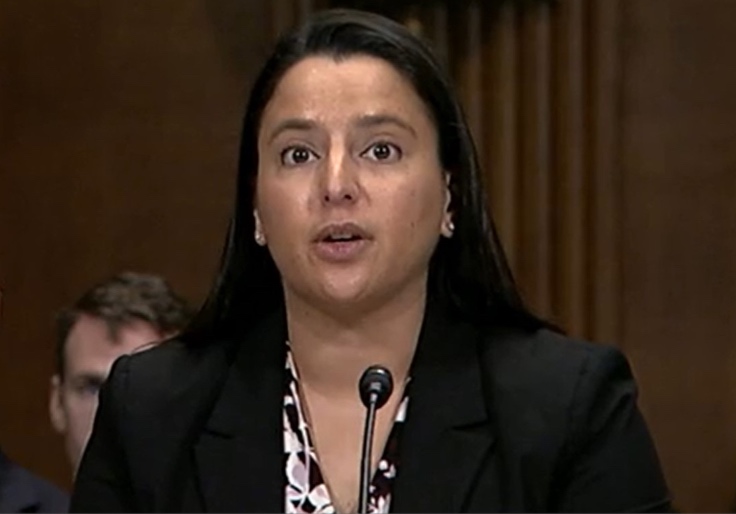
A federal judge who teaches a course at George Washington University's law school recused herself from an antisemitism case against the university—but only after she taught the course for three months and argued that her connection to the defendant did not create a conflict of interest. That judge, Biden appointee Loren AliKhan, said her employment didn't create any conflicts and was prepared to stay on the case until one party formally objected.
Legal experts said AliKhan displayed a "shocking ignorance" of basic ethical concepts by failing to voluntarily withdraw immediately.
AliKhan said during an April 20 conference that she didn't realize her GW Law employment "could create the appearance of a lack of impartiality" until she began "digging into the merits of the defendant's pending motion." After consulting with the federal court system's lead ethics attorney—who, according to AliKhan, said "it was unlikely that recusal would be warranted" because George Washington is a "large university" and the lawsuit did not explicitly target the law school—AliKhan determined there was no "objective basis on which my impartiality could be questioned."
AliKhan said she would only step down if at least one party anonymously requested she do so, though an attorney for the plaintiffs, Jason Torchinsky, had already publicly said he believed AliKhan needed to recuse. A motion calling on AliKhan to withdraw from the case was filed on April 22, and U.S. District Judge Trevor McFadden was randomly assigned to take over the case.
It's unclear exactly what AliKhan asked the ethics attorney about her recusal or what the attorney's precise answer was—the judge did not respond to questions from the Washington Free Beacon, and the federal court system's administrative office declined to comment. Law professors, however, told the Free Beacon that AliKhan should have recused as soon as GW Law hired her.
"To begin with, it is astonishing that a federal judge would not voluntarily (indeed, routinely) recuse herself from a case in which she was employed, even part-time, by one of the parties," Keith Fisher, an associate professor at St. Thomas University College of Law who wrote legal briefs on behalf of the American Bar Association for a Supreme Court case involving a judge's refusal to recuse, said. "For a smart woman, Judge AliKhan displays shocking ignorance about several rather basic legal and ethical concepts."
He added that her failure to immediately recuse or even disclose her GW Law employment establishes a "violation of judicial ethics" and that "continuing to preside over this case"—as she planned before the joint motion—would create an "appearance of impropriety." He also pointed out that GW's faculty code makes clear that the university is not a distinct entity from the law school.
Seth Oranburg, a law professor at the University of New Hampshire's Franklin Pierce School of Law, criticized AliKhan's attempts to stay on the case leading up to her recusal.
"Instead of recusing herself, which is the ethical way to handle an appearance of impropriety, Judge AliKhan invoked a 'remittal' procedure that allows parties to waive her apparent conflict of interest," Oranburg told the Free Beacon. "The problem is that this procedure depends on anonymity. Here, Judge AliKhan obviously knows the Plaintiff seeks her recusal. Unless she deletes that part of her brain, her efforts to remain on this case only deepen the appearance problem that made her recusal overdue in the first place."
The code of conduct cited by the ethics attorney AliKhan consulted, whom she did not name and who is not explicitly identified on the federal court system's website, states that judges should withdraw if their "impartiality might reasonably be questioned." Yet Fisher pointed to the same guidelines just days before the conference and said AliKhan "falls within the literal language."
The lawsuit alleges that GW violated Title VI of the Civil Rights Act by allowing a "hostile educational environment" to flourish unchecked. It details a litany of incidents against Jewish students, including physical assaults, vandalism, and verbal harassment, with university administrators allegedly turning a blind eye.
One of the plaintiffs, Sabrina Soffer, said AliKhan's recusal will "ensure the integrity of the proceedings and remove any appearance of bias or conflict, allowing the case to move forward transparently and on its merits."
"While recusal should have occurred immediately upon Judge AliKhan accepting the position with the University, it was ultimately the correct decision," she said.
Torchinsky, her attorney, told the Free Beacon he was thankful the case can promptly continue.
"We are glad that the court so promptly re-assigned a new judge, and we are looking forward to seeing the case move forward," he said in a statement.
AliKhan began presiding over the lawsuit in May 2025. It's unclear when she was hired, but she began teaching a corequisite course on "judicial lawyering" for GW Law School's Field Placement Program in early January. Topics covered in the class include "protocol, professionalism, judicial decision-making," "an attorney's ethical duties and discretionary judgment," and "the attorney's role in creating a legal system that should provide equal access and eliminate bias, discrimination, and racism in the law," according to a course bulletin.
AliKhan didn't acknowledge a potential conflict of interest until roughly two months later, when she issued a 10-day stay on March 30 "to assess whether she has a conflict that warrants her disqualification, disclosure to the parties, or other appropriate action." During the April 20 conference, she offered an explanation for the delay. She said she and her clerks "review every case for potential conflicts when the case is first assigned" and "periodically go through all of our 300-plus cases," but sometimes "questions arise once we start digging into the meat of a pending motion and into the record, which is what happened here."
GW did not respond to requests for comment.
The post Federal Judge Who Doubles as George Washington University Lecturer Recuses Herself From Antisemitism Case Against the School After Arguing There Was No Conflict of Interest appeared first on .