

Black Users More Likely To Share Social Media Content, Fired Washington Post Columnist Wrote in Performance Self-Evaluation

Washington Post columnist Karen Attiah’s social media posts after the shooting of Charlie Kirk could harm the journalistic reputation of the Washington Post and "were ill-timed," but didn’t amount to the "gross misconduct" required by a union contract to justify firing Attiah, who had worked at the newspaper for 11 years.
That’s the ruling of an impartial arbitrator, Sarah Miller Espinosa, who issued a decision August 20 ordering the Post to reinstate Attiah to her job and pay her wages and benefits.
Whether that means Attiah, a fierce critic of America and of Israel who often writes about black identity, will return as a Post columnist is unclear. The arbitration decision discloses that the Post "planned to reassign" Attiah "from Opinion Columnist to Letters Editor." While her pay and benefits would have remained unchanged under that plan, her own voice would have been limited from its previous reach as a columnist whose work reached Post readers under headlines such as "I Gained 20 Pounds of Muscle. Here’s What I Learned," and "What the assault on DEI Will Really Mean: Resegregation," and "Black women are the face of America’s ugly Gaza policy."
The arbitration decision illuminates how labor agreements can limit the ability of newspaper owners to manage their publications. It also offers an unusually detailed and not particularly flattering window into the internal operations of the Post. The paper, while much diminished from its days of peak influence, is owned by Jeff Bezos, one of the richest people in the world, and is in the midst of an attempted repositioning of its opinion section to support "free markets and personal liberties."
The 39-page decision by the arbitrator begins by quoting the relevant provisions of the contract between the Post and the Washington-Baltimore Newsguild, a local of the Communications Workers of America. The CWA, which also represents journalists at the Associated Press, Politico, the New York Times, New York magazine, and the New Yorker, endorsed Kamala Harris for president in 2024. A section on "management rights" makes clear that "except as limited by a specific provision of this Agreement, The Post retains the exclusive right to manage and operate the business, to direct and control the work force, and to make any and all decisions affecting the business." A separate section, on "job security," states, "No employee shall be discharged except for good and sufficient cause."
The arbitration case turned on whether the reasons the Post offered, in writing and in the arbitration proceedings, amounted to "good and sufficient cause." A termination letter cited social media posts Attiah made to the Bluesky platform. "Refusing to tear my clothes and smear ashes on my face in performative mourning for a white man that espoused violence is … not the same as violence," one post said. "Part of what keeps America so violent is the insistence that people perform care, empty goodness and absolution for white men who espouse hatred and violence," another one said.
"Your public comments on social media regarding the death of Charlie Kirk violate The Post’s social media policies, harm the integrity of our organization, and potentially endanger the physical safety of our Staff," the termination letter said.
The arbitrator said Post management’s "endanger the physical safety" language—ironically reminiscent of the New York Times employee union’s campaign against an opinion piece by Senator Tom Cotton, which called the Cotton op-ed "a clear threat to the health and safety of journalists we represent"—was bogus.
"The Post’s witnesses’ testimony seems to attempt to hold the Grievant accountable for the actions of bad actors who were posting threats against her and The Post on social media," the arbitrator writes. "The testimony implies that The Post’s leadership believed summarily discharging the Grievant would placate the bad actors so that they would not commit violence against other Post employees. The Arbitrator finds it strange for The Post to argue it had just cause to terminate the Grievant, in part, because, if it didn’t immediately do so, criminals may commit violence against other employees. The Arbitrator wonders about the Post’s logic in that it fails to recognize it is the people making the threats who are responsible for their own behavior, not the Grievant. To imply that the Grievant’s posts were justifiable provocation for threatened criminal acts or that the Grievant’s employment may be terminated for just cause because bad actors threatened The Post is unsupportable."
Beyond the legal points, though, the text of the decision discloses how Attiah’s defense lawyers used Post management language to push back against the Post’s attempt to fire Attiah. It quotes Attiah’s 2021 Annual Performance Appraisal self-assessment. "I have built a sizable following on Twitter (246,000) and on Instagram (22,600) which I have used in the past to not only promote pieces, but generate discussion amongst younger and more diverse audiences. Studies have shown that Black users in particular are more likely to create share [sic] political content on social media like Facebook and Instagram – so these platforms will be key for the future."
It’s not clear what "studies" Attiah was referring to. A 2025 Pew survey on social media use found 74 percent of blacks using Facebook and 54 percent using Instagram, compared to 71 percent and 50 percent of the general population. The margin of sampling error for non-Hispanic blacks in that survey overall was 4.8 percentage points (the unweighted sample size was 513 people), so the margin of sampling error for black Facebook or Instagram users would have been even larger. A 2020 Pew survey also looked at the issue, but the racial variation may have been a result of the Black Lives Matter movement, the election year, or partisan differences.
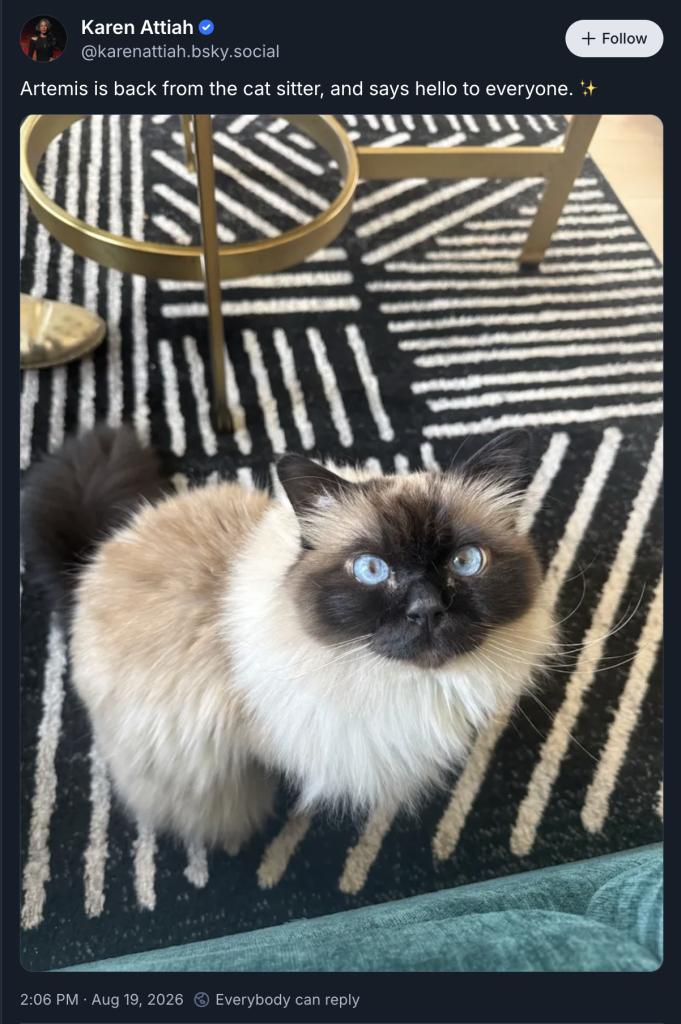
Attiah’s managers wrote back in their section of the performance review, "We agree with Karen’s self-evaluation here. She is a forceful presence on social media, offering her followers an appealing mix of sharp, timely commentary on vital issues and relatable glimpses into her personal life (her cat Artemis is something of a social media star). She is a leader by example as our section strives to employ social media to expand the reach of our journalism and to connect with and serve new audiences that are important to the Post’s future."
Attiah’s advocates also pointed to, and publicized, her previous writings, and management reaction to them, in pushing back against the Post’s complaint about her social media posts. The arbitration decision quoted a January 13, 2025 email to Attiah from the Washington Post’s then-publisher, Will Lewis, subject line, "Well done," "I wanted to drop you a note to thank you for sharing your exchange with Meta’s Black AI character," it said.
The decision quotes, and relies on, the union’s argument that her social media posts about Kirk were in keeping with her Post columns. It says, "The Post itself publishes articles and columns specifying the race and gender of individuals. In fact, the Grievant wrote a column to which The Post attached the headline ‘Harris and Black women are face of Biden administration’s ugly Gaza policy.’"
Attiah’s Substack, established in September 2025 after she was fired by the Post, claimed she was fired in part for "Speaking out against … racial double standards." An article on the Substack featured a photo of Attiah seated next to a white-tie wearing Bezos at the 2019 Gridiron dinner. "I was the last remaining Black full-time opinion columnist at the Post, in one of the nation’s most diverse regions. Washington D.C. no longer has a paper that reflects the people it serves. What happened to me is part of a broader purge of Black voices from academia, business, government, and media — a historical pattern as dangerous as it is shameful — and tragic," she wrote. Another post is headlined, "The Washington Post Fired Me for Talking About Race."
Attiah greeted America’s 250th with a July 4 column that concluded by asking, "is there much to celebrate about America at 250? A young, immature country that has more strength than sense? That still mistakes power for wisdom, and force for maturity, and violence for legitimacy?"
In addition to the Substack, Attiah since leaving the post founded an online education platform called the Resistance Studies Series that offered "Salons" featuring "lessons from the anti-Zionist resistance."
The Post, the Washington Post Union, and the Democracy Defenders Fund, which says it supported Attiah, did not immediately respond to requests for comment.
The post Black Users More Likely To Share Social Media Content, Fired Washington Post Columnist Wrote in Performance Self-Evaluation appeared first on .
 Like
0
Like
0
 Dislike
0
Dislike
0
 Love
0
Love
0
 Funny
0
Funny
0
 Wow
0
Wow
0
 Sad
0
Sad
0
 Angry
0
Angry
0





Comments (0)