

5 Things to Know About California’s Backlog of Police Shooting Investigations


Under growing pressure from a restive public during the summer of 2020, the Legislature passed a bill that put police shootings of unarmed people under the jurisdiction of the California Department of Justice.
The belief, at the time, was that pulling investigations from local prosecutors — the same prosecutors who relied on police officers to testify in criminal cases — would reduce conflicts of interest and restore faith in a judicial system that was the subject of nationwide protests after the police killing of George Floyd in Minneapolis.
In its five years since then, the police shooting program has closed 41 cases. It has never recommended charges against an officer who shot and killed an unarmed person. CalMatters originally looked at this program after its first year, and returned to investigate the program in its fifth.

Nigel Duara
CalMatters
Here’s what we found:
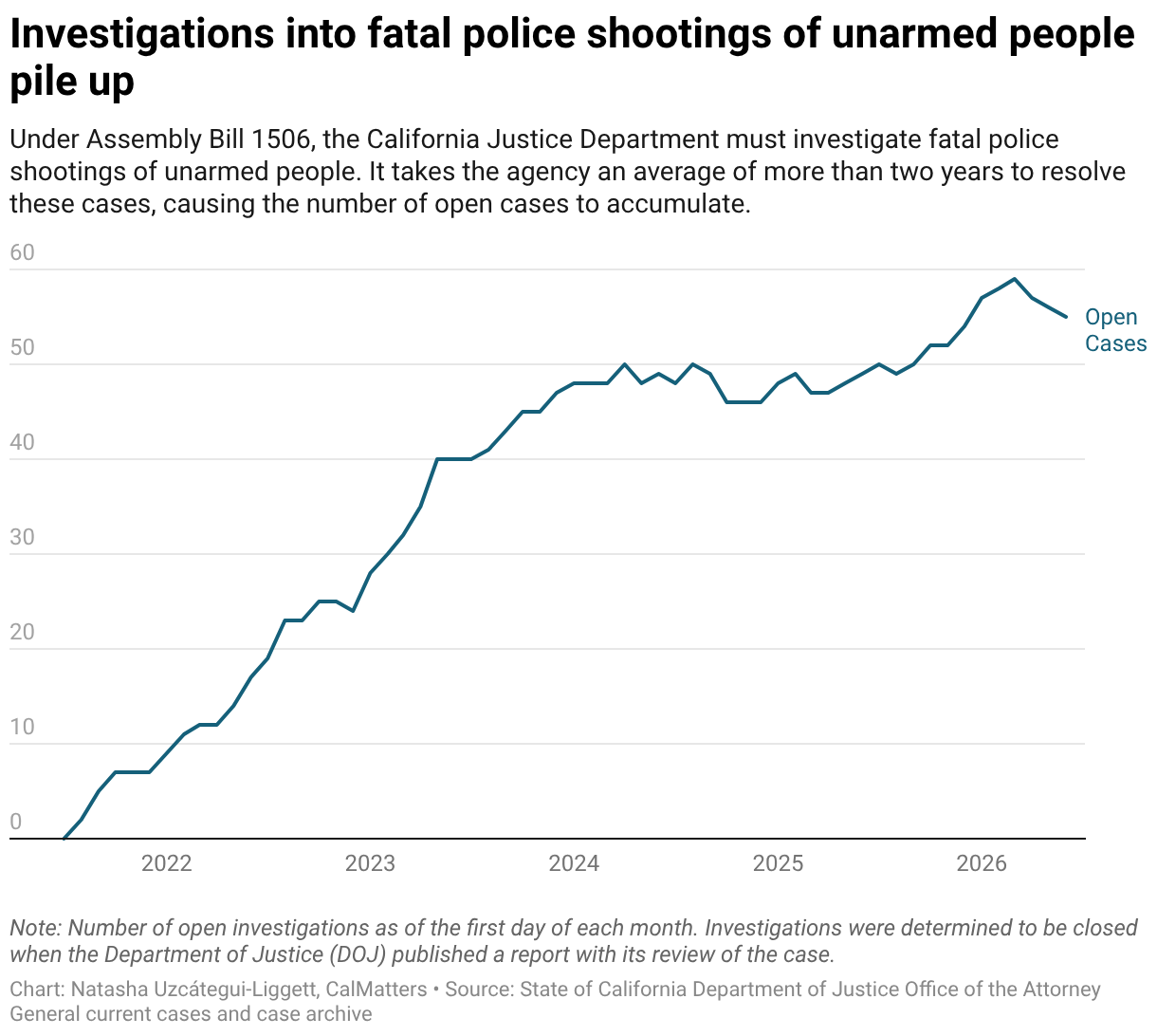
Investigations Take Longer
Attorney General Rob Bonta originally pledged to close shooting investigations within one year. That still hasn’t happened.
The average investigation takes nearly two years and five months. Eight investigations, including a cluster of cases in rural Northern California, stretched past three years.
The Department of Justice has argued that it is underfunded. The police shooting program got just $13 million annually, despite asking for $26 million. On its first investigation, program investigators were already complaining that they were undermanned.
Some Exceed Statutes of Limitations
When anyone is accused of a crime, police officer or not, the state has a set limit of time to file charges. For 92% of crimes in California, that time limit is three years. For certain crimes, like murder, there is no statute of limitations.
When the Department of Justice investigations stretch past three years, that means that an officer can’t be charged with certain crimes potentially involved in the case — crimes that have previously been leveled at officers who shot and killed people. Some of the crimes that the Justice Department can’t charge after three years include involuntary manslaughter and aggravated assault.
Blowing Past Decertification Deadline
One year after California established its police shooting investigation program, the Legislature passed a law that would allow police departments to decertify officers for serious misconduct, stripping their license to work in law enforcement.
But decertification has a time limit, too: three years.
So when investigations stretch past three years, the Department of Justice can no longer recommend any officer lose their certification.
The certification program is run by a state agency, the California Commission on Peace Officer Standards and Training, or POST. POST told us that it can start investigations on its own if an officer is accused of serious misconduct.
Was Local Accountability Better?
Before the police shooting investigation program went into effect, many law enforcement leaders and district attorneys predictably opposed it.
But some liberal, reform-minded prosecutors also had their doubts about its potential. Specifically, they worried that taking the investigations out of the hands of locals would dilute the pressure that people could put on their district attorney.
Now, the cases go to Sacramento. A county district attorney never has to answer for the decision to charge or not charge a police officer.
“Local concern, local protests, local interest is felt by local prosecutors,” said Cristine Soto DeBerry, who created a unit investigating police officers at the San Francisco District Attorney’s Office, where she was chief of staff.
Local Investigators Back Off
Local police and sheriff’s departments are still supposed to do their own investigations into police shootings. After all, someone was killed in their jurisdiction. Bonta’s office says nothing in the law prevents local authorities from conducting their own parallel investigations.
But we found that, as a practical matter, local authorities take a hands-off approach once Bonta’s office steps in.
“If the case meets the criteria under (the police shooting law) and DOJ confirms they are taking over the investigation, we do not do a parallel criminal investigation of our own or do a criminal investigation of our own after DOJ concludes their investigation,” said Capt. Brian Cole, who oversees the detective division at the Redding Police Department. “They have complete criminal jurisdiction of the matter.”
Although the Justice Department maintains that it’s only looking at the potential criminal culpability of an officer, in practice, that means that theirs is the only shooting investigation once they take over.
This story was originally published by CalMatters. Sign up for their newsletters.
This article was originally published on CalMatters and was republished under the Creative Commons Attribution-NonCommercial-NoDerivatives license.
The post 5 Things to Know About California’s Backlog of Police Shooting Investigations appeared first on GV Wire.
 Like
0
Like
0
 Dislike
0
Dislike
0
 Love
0
Love
0
 Funny
0
Funny
0
 Wow
0
Wow
0
 Sad
0
Sad
0
 Angry
0
Angry
0




Comments (0)